

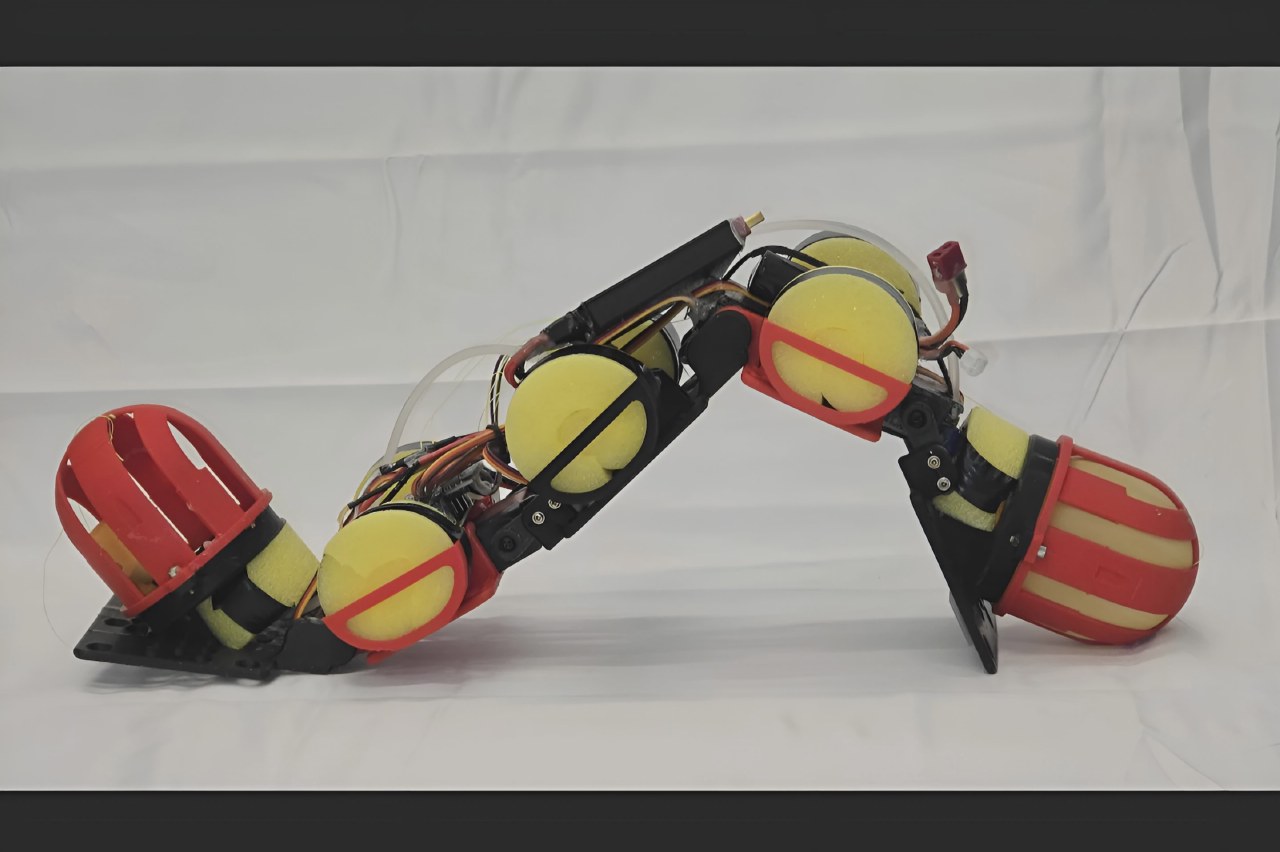
The WorMa robot, developed by researchers at NYU Tandon School of Engineering, measures 50 cm in length, 13 cm in width, and 10 cm in height, weighing approximately 1.063 kg. It features five rigid segments, four joints, and two latex water bladders at the head and tail, connected by a 12V peristaltic pump.
The system operates by shifting 300 grams of water, representing 28% of its total weight, between the ends to adjust its center of gravity. This mechanism allows the robot to navigate slopes, stairs, and water. In tests, a head-heavy configuration enabled the robot to climb a 19.5-degree slope and provided necessary traction to exit water.
For stair climbing, the robot requires a sequence of weight shifts, allowing it to clear obstacles up to 15 cm high. While the robot demonstrated the ability to traverse varied terrain, the current prototype is remotely controlled and lacks autonomous terrain recognition. Shifting the water takes approximately 110 seconds.
The research, published in Advanced Robotics Research, notes that the robot is currently a laboratory prototype. Future development plans include increasing pump speed and integrating sensors with closed-loop control to address issues like lateral drift in water and slow response times.


