

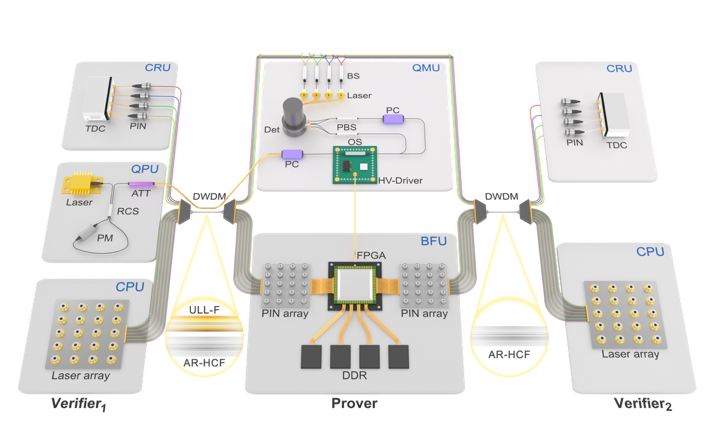
A research team from the University of Science and Technology of China, in collaboration with Guangdong University of Technology, has successfully implemented a quantum-secure positioning system. The project combines quantum mechanics principles with relativistic space-time constraints to ensure verifiable and secure location tracking.
Traditional positioning systems are vulnerable to spoofing, as attackers can replicate or forward verification data. The new quantum approach leverages the no-cloning theorem to provide information-theoretic security, preventing unauthorized location forgery.
To overcome experimental challenges, the team developed a protocol using weak coherent states and a Sagnac-based quantum state preparation scheme. This reduced the quantum bit error rate to 0.27 percent, significantly improving the system's tolerance to transmission losses.
The researchers utilized multi-wavelength intensity encoding, hollow-core fiber transmission, and high-speed random logic processing to minimize system latency to the nanosecond scale. These technical advancements resulted in a positioning accuracy better than 75 meters.
The findings, published in the journal Nature Physics, demonstrate the feasibility of quantum-secure positioning in real-world conditions. Potential applications include secure asset tracking, disaster rescue operations, and identity verification for financial transactions or sensitive data access.

