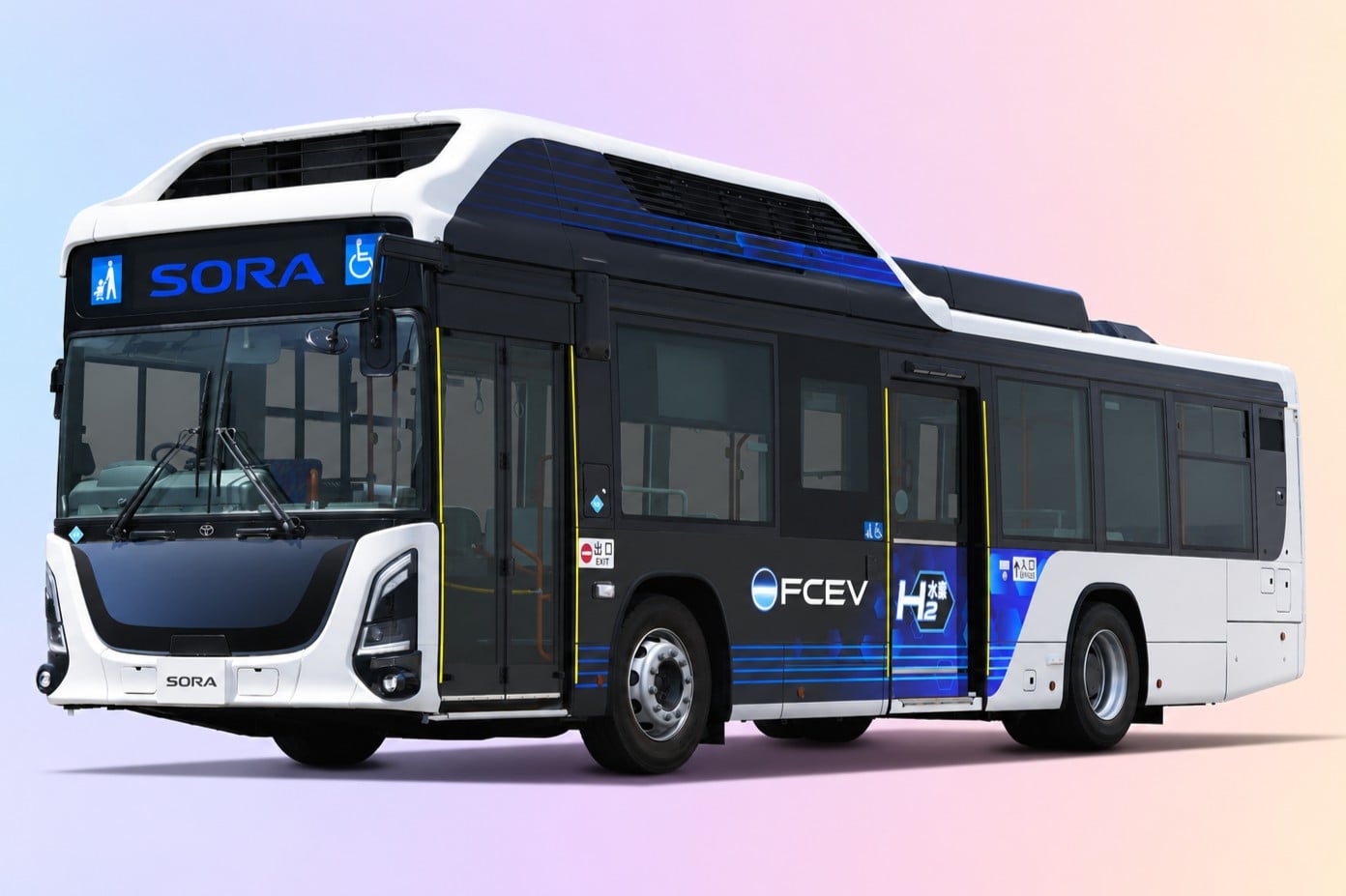
Toyota has launched the second generation of its Sora hydrogen fuel-cell bus in Japan, developed in partnership with Isuzu. The vehicle is built on Isuzu’s flat-floor battery-electric platform and utilizes a Toyota fuel cell stack, which has been relocated to the front of the roof. The design now features three larger-capacity hydrogen tanks arranged in a single row, replacing the previous ten-tank layout.
Despite a 21.5 per cent reduction in fuel capacity to 471 litres, the new Sora offers a range exceeding 300 kilometres, an increase of about 100 kilometres over the previous model. This improvement is attributed to a more efficient fuel cell stack and a new lithium-ion battery, which replaces the former nickel-metal hydride unit. The bus is powered by two AC induction motors, each delivering 110 kW and 485 Nm of torque.
The bus measures 10.5 metres long, 2.5 metres wide, and 3.4 metres high, featuring a fully flat floor to improve passenger accessibility. Toyota offers four variants for urban and suburban use, with one urban configuration supporting up to 69 passengers. Safety features include an Emergency Driver Stop System and a front blind spot monitor to detect pedestrians and cyclists.
Toyota has not yet announced pricing, commercial rollout plans, or details regarding potential exports for the second-generation Sora.