

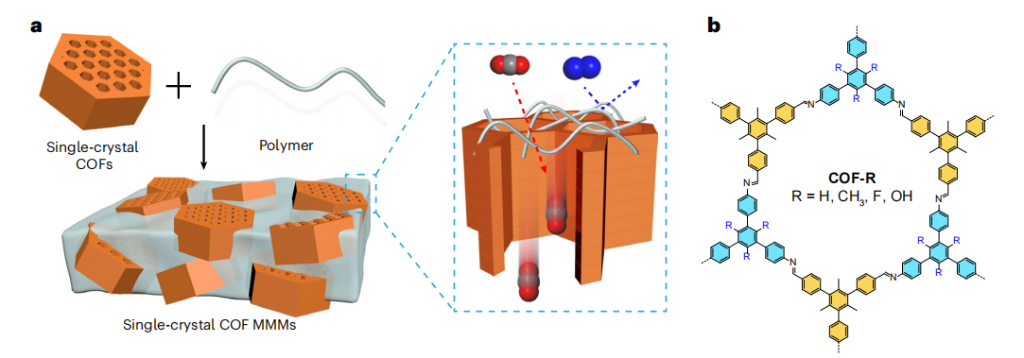
Researchers from Tianjin University, led by Jiang Zhongyi and He Guangwei, have developed a new all-organic mixed-matrix membrane for carbon capture. The team utilized a strategy inspired by cell membrane structures to integrate single-crystal covalent organic frameworks (COFs) into polymers, achieving a filler volume fraction of 75.5%.
The membrane demonstrates a carbon dioxide permeability of 74,800 Barrer while maintaining a carbon dioxide/nitrogen selectivity of approximately 20. This performance significantly exceeds commercial polymer membranes, which typically operate in the range of tens to low hundreds of Barrer in post-combustion scenarios.
The material maintains stability under conditions involving moisture, sulfur oxides, and nitrogen oxides. Preliminary economic analysis indicates that the carbon capture cost using this technology is approximately $38 per ton of carbon dioxide, which aligns with recent industry advancements in cost reduction.
The research, published in Nature Energy on October 7, involved collaboration with institutions including the Swiss Federal Institute of Technology Lausanne and the University of Southern California. The development aims to address the industrial challenge of high-energy and high-cost carbon capture in sectors like power, cement, and steel.

