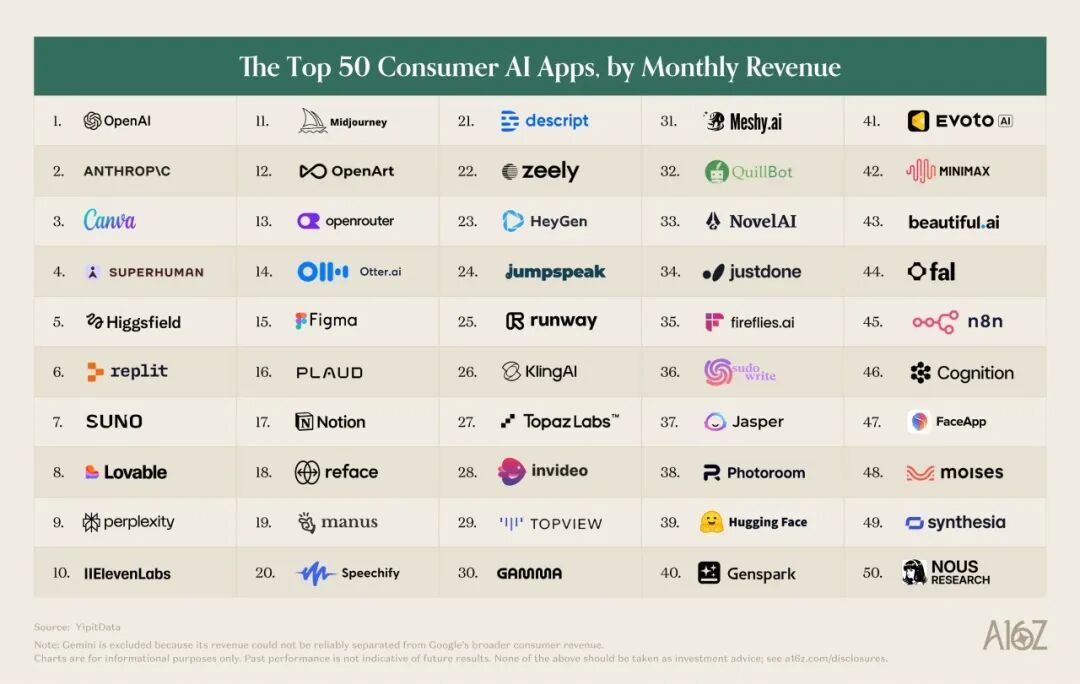
A16z's seventh report on top AI consumer applications reveals a shift in market metrics. Only 11 new products entered the list, a record low, as traffic data becomes less representative of actual usage. The firm now incorporates YipitData credit card transaction records to analyze real consumer spending.
The market exhibits a power-law distribution: the top 1% of paying users contribute 19.5% of total revenue, exceeding the combined spending of the bottom 50%. These power users spend an average of $903 per month on AI tools, with their expenditure growing by 80% over the last 18 months, while average users spend $25.
There is a significant gap between traffic and revenue rankings, with 29 of the top 50 revenue-generating AI providers absent from traffic-based lists. Only seven companies, including ChatGPT, Claude, Suno, Perplexity, Photoroom, Canva, and Notion, appear in both.
Competition among major players remains intense, with Anthropic, Google, and OpenAI launching 127 new products in six months. ChatGPT leads in traffic and subscription numbers, while Claude has seen significant growth, with 7.3% of its users opting for the $100 monthly plan, compared to 1.3% for Google and 1.1% for ChatGPT.
A16z identifies four survival strategies for startups: focusing on vertical niches like Suno, offering model-agnostic platforms like Cursor, addressing privacy and compliance, and integrating hardware with software, as seen with Plaud. Currently, 84% of AI-native products rely on subscriptions.
The industry is exploring new business models beyond subscriptions, such as transaction commissions and advertising, to reduce reliance on user fees. As AI agents gain traction in programming and automation, they may shift the market toward infrastructure-based revenue models.