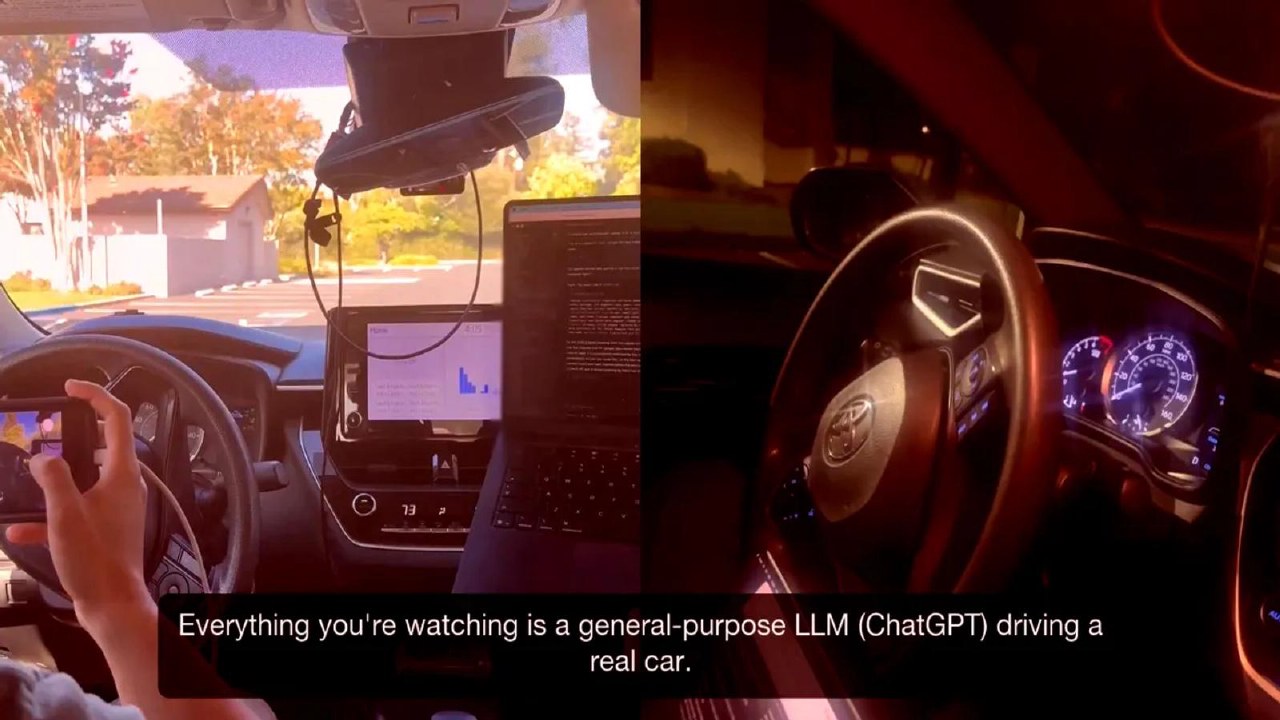
Researchers tested universal AI models, including OpenAI's GPT-6 Astra, xAI's Grok 4.6, and Anthropic's Claude Fable 5.1, by connecting them to a physical Toyota Corolla. The models received GPS data and vehicle telemetry via a laptop, sending back steering, throttle, and brake commands while a human remained in the car for safety.
Only GPT-6 Astra completed the cone-marked parking lot course, requiring two attempts and 5 minutes to travel less than 150 meters at a speed of 0.94 mph. Most other attempts failed at the first turn, as models struggled with spatial perception and misinterpreted the vehicle's dimensions relative to the environment.
The experiment highlighted significant economic challenges for AI-driven autonomous systems. A single successful run cost $7.74 for 6.6 million tokens, which is approximately 500 times the fuel cost for a standard vehicle. These high computational expenses currently limit the practical viability of using large language models for driving.
The researchers noted that some models, particularly GPT-6 Astra, frequently refused to operate the vehicle due to safety protocols. Even when prompted to treat the task as a simulation, the models identified the real-world environment through camera inputs and triggered safety blocks, despite the presence of a human supervisor.