

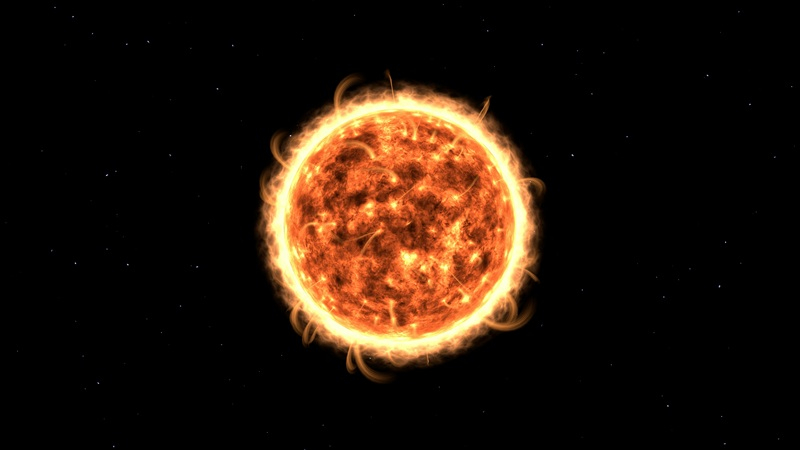
A new study led by Konstantin Batygin from the California Institute of Technology suggests that the solar system is highly unstable. Researchers modeled the future evolution of the Sun as it transitions into a red giant and eventually a white dwarf.
Previous scientific estimates suggested that outer giant planets could survive for up to 100 billion years after the Sun dies. However, the new findings published in The Astrophysical Journal Letters indicate that these planets are unlikely to last more than one billion years after the Sun becomes a white dwarf.
The study, titled 'The Ultimate Instability of the Solar System Induced by Stochastic Solar Mass Loss', concludes that the solar system will face chaotic destruction during the red giant phase. This process will involve the Sun consuming Mercury, Venus, and potentially Earth.
Researchers noted that the system's collapse is not driven by entropy or external stellar encounters. Instead, the Sun's own death and mass loss will destabilize the orbits of the remaining planets, contradicting earlier theories that predicted a much longer lifespan for the planetary order.


