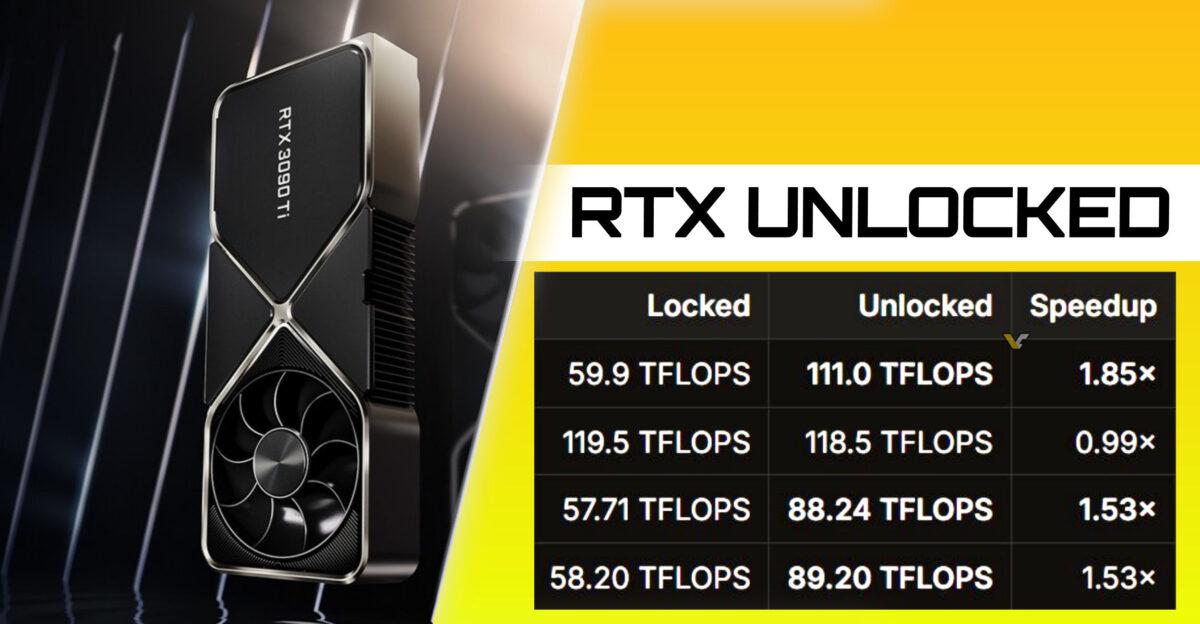
Enthusiasts have developed a software method to bypass Nvidia's performance restrictions on Tensor Core units in older GeForce RTX graphics cards. The GPU-Unlock project, created by developer Zagitta, modifies low-level GPU configuration registers before the driver loads to increase instruction execution speeds.
The modifications are temporary and reset once the power is cycled. No hardware changes or BIOS flashing are required to implement the fix. The performance boost primarily affects FP16 and BF16 operations with FP32 accumulation, as well as specific TF32 and FP8 workloads on supported architectures.
For the RTX 3090 Ti, matrix multiplication performance in BF16 increased from 87.5 to 157.4 TFLOPS. Similar improvements were observed across the RTX 20 and RTX 40 series. The update accelerates AI tasks like matrix multiplication, LLM prompt processing, and image generation, though it does not affect gaming performance or memory bandwidth.
The impact varies by task. LLM request processing speeds increased by 14–36%, while token generation remains largely unchanged. The lack of hardware limitations on memory capacity or bandwidth remains a constraint for these cards despite the increased computational power of the Tensor Cores.