

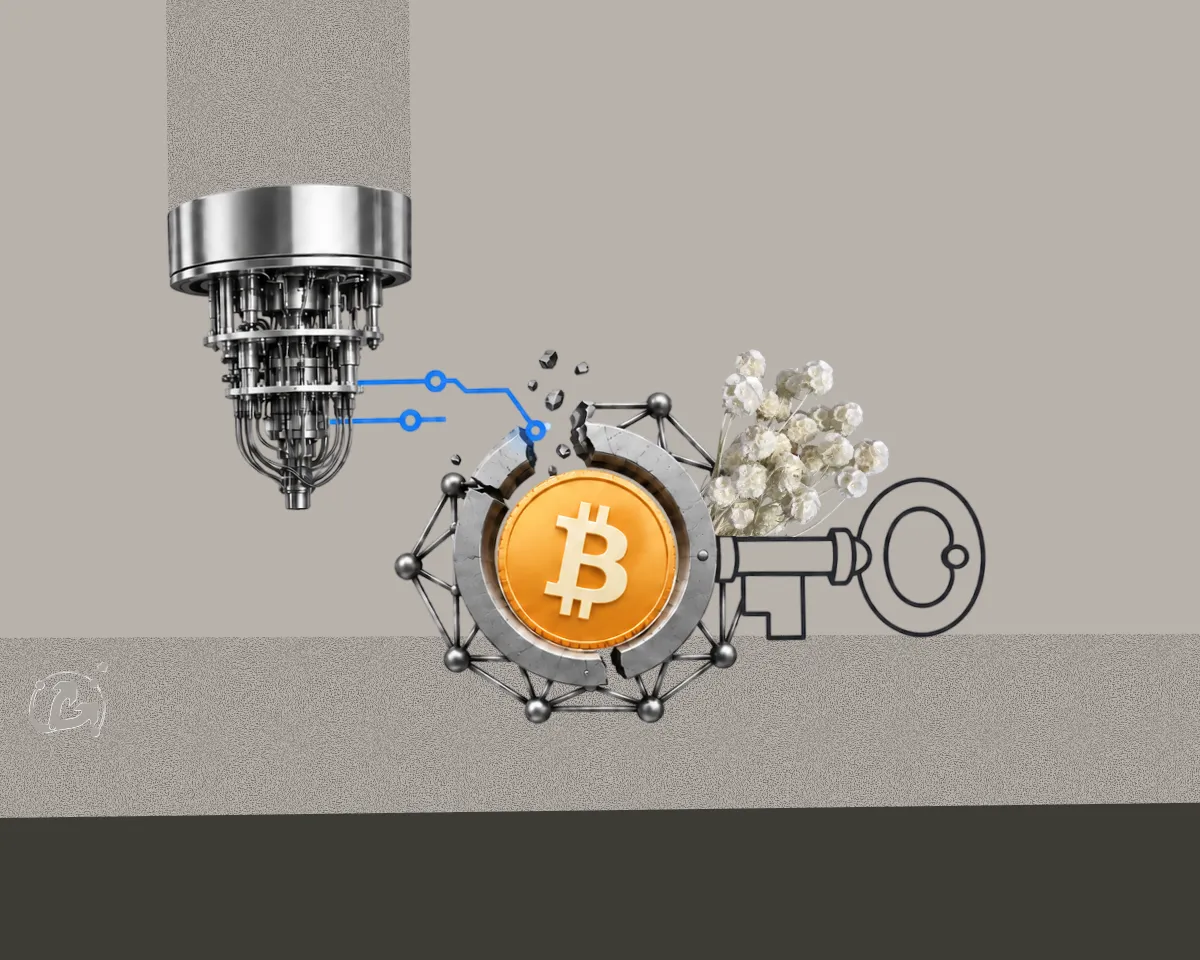
Shor's algorithm, introduced by Peter Shor in 1994, poses a theoretical threat to asymmetric cryptography by solving integer factorization and discrete logarithm problems in polynomial time. This capability could potentially compromise RSA, ECDSA, and Schnorr signatures, which are foundational to Bitcoin's security.
Current quantum hardware remains far from this threshold. While IBM's processors contain around 1,100–1,200 physical qubits, a fault-tolerant machine capable of breaking Bitcoin's secp256k1 curve would require approximately 20,000 logical qubits. Recent estimates for ion-trap systems have dropped from millions to 10,000–20,000 physical qubits.
In April 2026, researcher Giancarlo Lelli demonstrated a 15-bit key hack on IBM hardware, a 512-fold increase over previous records. However, experts note that such experiments are far from the 256-bit keys used in Bitcoin. The current generation time for a single key on ion-trap machines is estimated at 26 days.
NIST has begun standardizing post-quantum cryptography, approving ML-KEM, ML-DSA, and SLH-DSA in 2024, with HQC expected by 2027. US government agencies plan to phase out RSA and elliptic curve cryptography by 2030, with a full ban by 2035. Industry leaders like Google and Microsoft target 2029 for a transition to post-quantum algorithms.
The blockchain community is exploring defensive measures, including the BIP-361 proposal for Bitcoin to freeze vulnerable coins and the use of account abstraction in Ethereum to support post-quantum signatures. Estimates for the arrival of a cryptographically dangerous quantum computer currently point toward the 2030s.

