

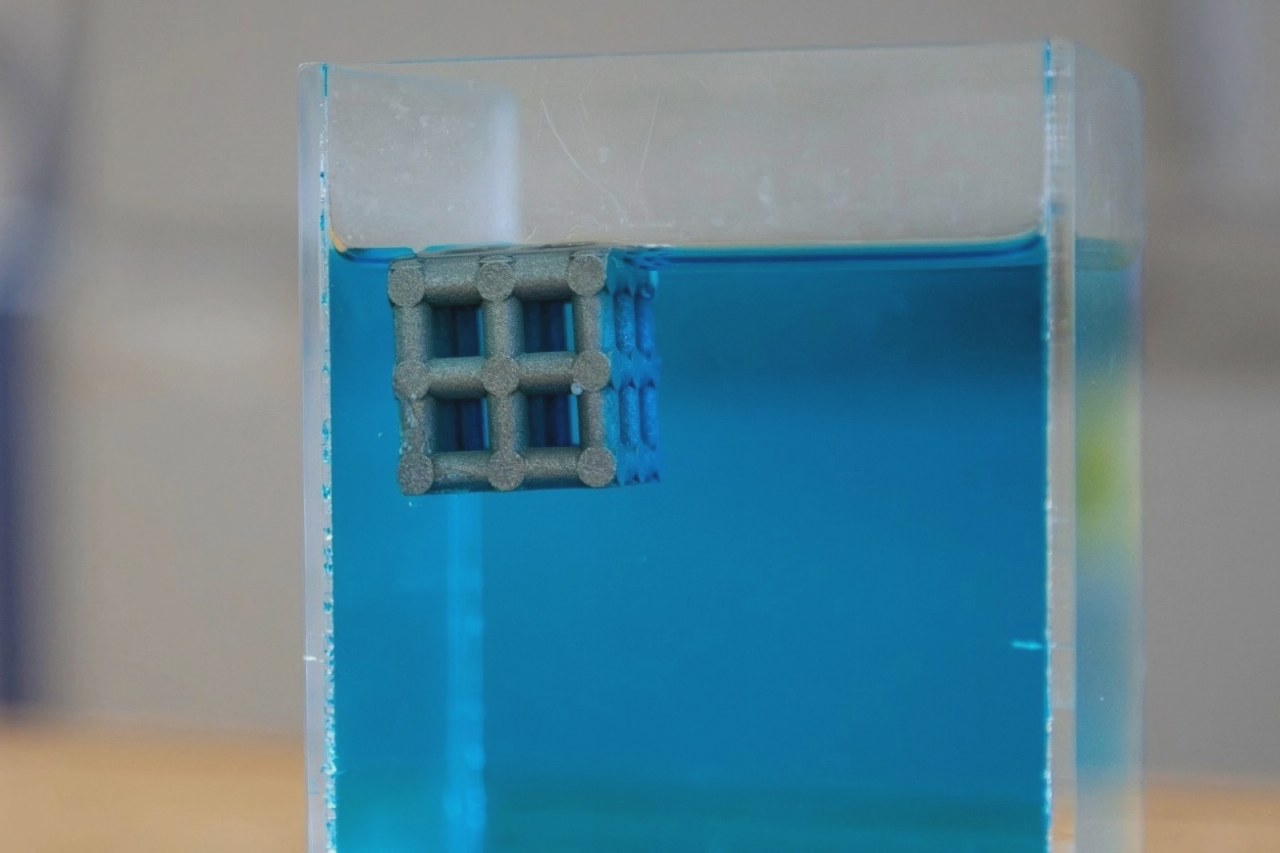
Researchers at RMIT University have developed a new buoyancy-capable titanium-polymer open-lattice metamaterial. By using 3D printing to create a Ti-6Al-4V titanium alloy framework with hollow struts filled with lightweight polyurethane foam, the team achieved a structure that remains buoyant while retaining high mechanical strength.
The material demonstrates significant resilience, maintaining its buoyancy even when suffering from cracks, broken connections, or partial damage to its lattice layers. This design allows seawater to flow through the open structure while the internal foam provides long-term, stable buoyancy, overcoming the limitation of titanium's natural density.
To evaluate this performance, the team introduced a new metric called 'skeleton density,' which accounts only for the volume that excludes water, rather than the entire lattice volume. This approach confirms that as long as the skeleton density remains below the density of the surrounding liquid, the structure will float.
Performance tests show the new titanium structure is approximately 70% stronger than stainless steel or high-density polyethylene used in marine engineering. In corrosion tests using natural seawater, samples lost only 0.15% of their mass and less than 1% of their strength after two weeks of immersion.
The material has successfully remained afloat in fresh water for over two months. This development is intended for applications in marine infrastructure, such as offshore platforms, monitoring sensors, and buoys, where high strength, corrosion resistance, and long-term durability are critical requirements.



