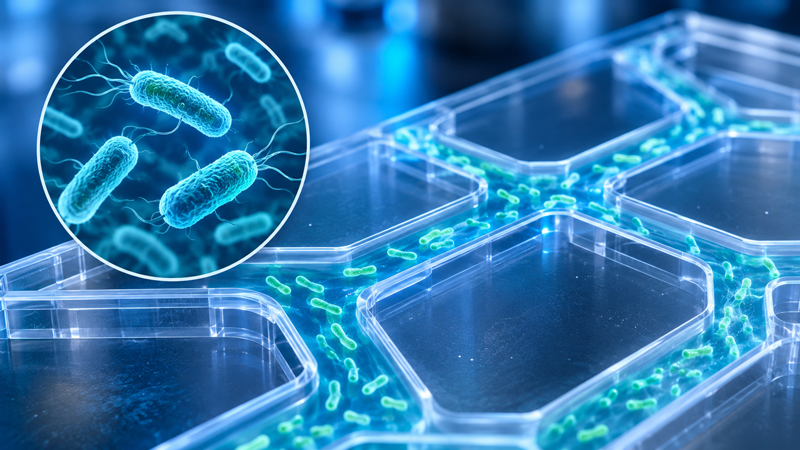
A research team led by McGill University has developed a biocomputer that utilizes motile bacteria to perform complex mathematical calculations. The system processes data by navigating a microfluidic network of channels, which represents various potential solutions to a problem.
The platform uses Escherichia coli HCB437 and Vibrio natriegens as biological agents. These bacteria move through a network made of polydimethylsiloxane, designed to function as logic gates. The system's efficiency relies on the bacteria's ability to reproduce during the computation, effectively increasing the number of active processing units.
Researchers applied this method to the NP-complete Subset Sum problem. By tracking the movement of bacteria through the channels, the team identified combinations that satisfied the problem's conditions. The study noted that V. natriegens showed a 0.3% error rate in node navigation, while E. coli showed a 1.3% error rate.
Dan Nicolau, the study's senior author, stated that this technology is not intended to replace traditional electronic or quantum computers. Instead, it serves as an energy-efficient tool for solving specific tasks, such as protein structure mapping, which are computationally demanding for conventional hardware.