

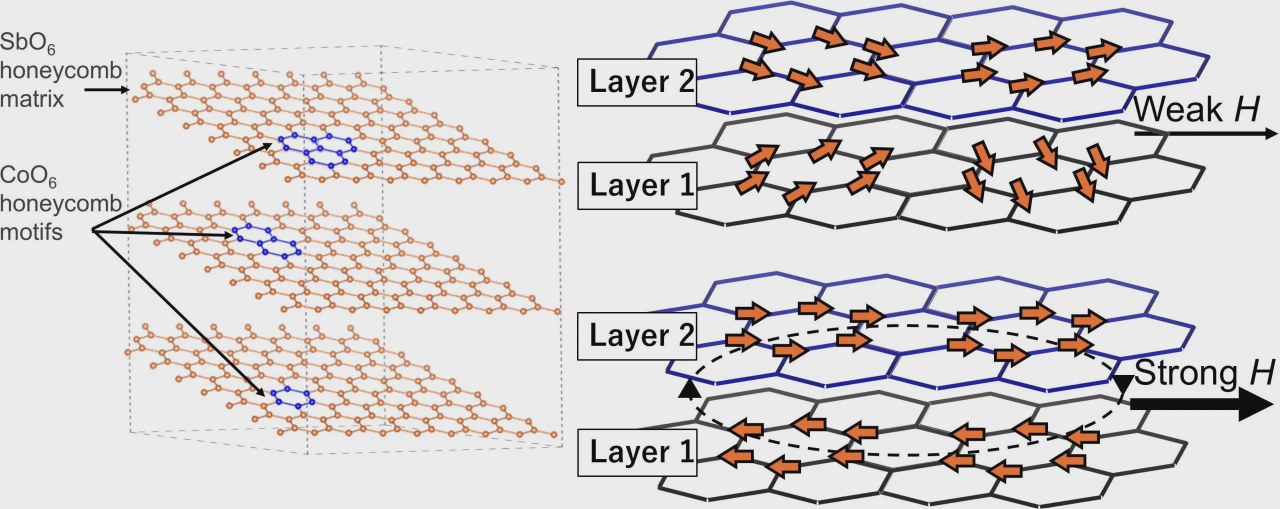
Researchers at Osaka University have developed a new material platform for quantum magnetism using cobalt, a more abundant and cost-effective alternative to rare metals like ruthenium and iridium. The team successfully integrated cobalt into a sodium antimonate (NaSbO3) substrate, which naturally possesses a layered honeycomb crystal structure.
By adding approximately 4% cobalt to the substrate, the team induced the formation of local CoO6 honeycomb structures without disrupting the overall crystal lattice. Microscopic analysis confirmed that the cobalt atoms arranged themselves into the desired geometry, avoiding the formation of unwanted secondary phases.
Magnetic measurements revealed that the material exhibits ferromagnetic-like behavior at approximately 88 Kelvin, or minus 185 degrees Celsius. Theoretical calculations suggest this magnetic response is directly linked to the specific arrangement of cobalt atoms within the local honeycomb structure, alongside interlayer antiferromagnetic coupling.
While the material displays Kitaev-type magnetic characteristics, researchers clarified that there is currently no evidence of a quantum spin liquid state. The study serves as a proof-of-concept for using common materials as templates to host specific magnetic structures, potentially simplifying the future development of quantum materials.

