

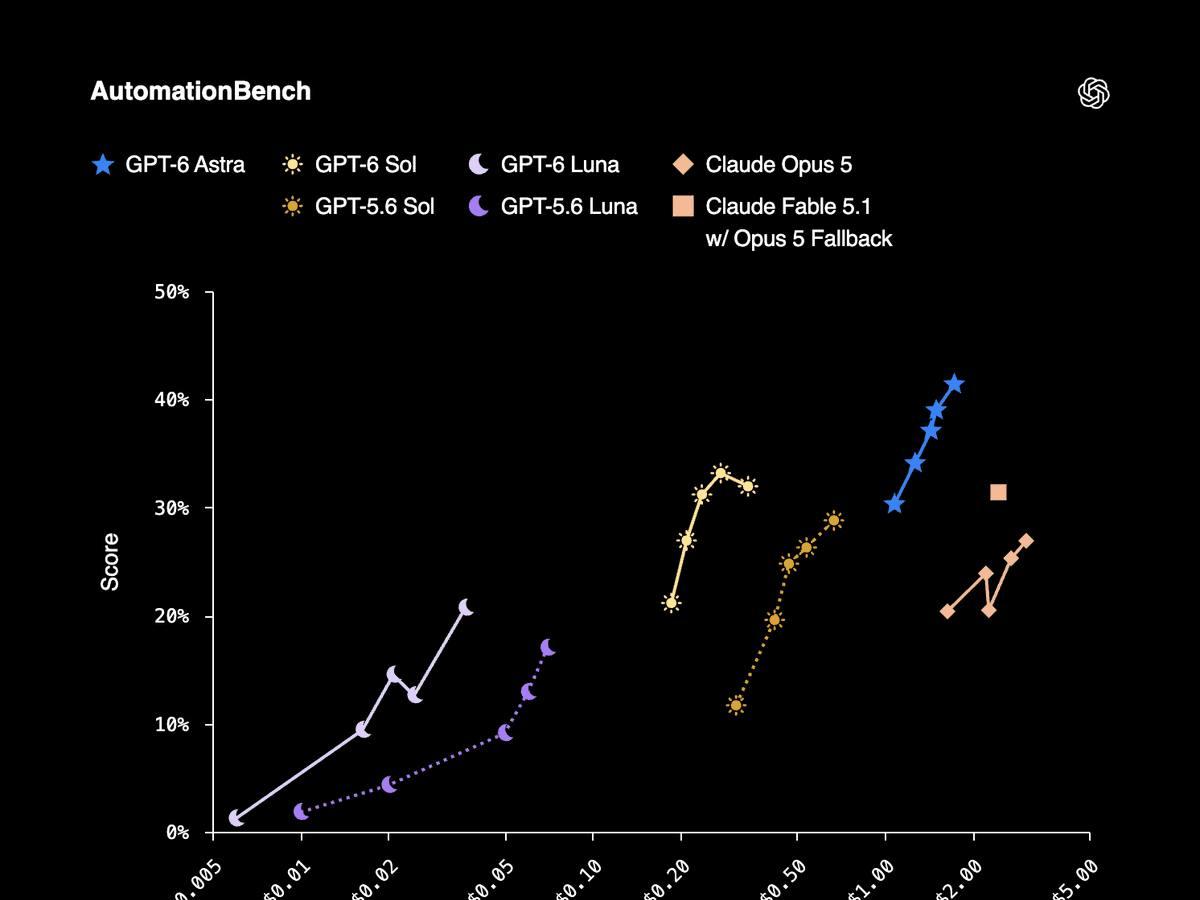
OpenAI has expanded its GPT-6 lineup with two new models, Sol and Luna. These models are designed for mass-market scenarios and utilize the same training methodology as the flagship Astra model. The release focuses on cost efficiency, with API prices reduced by 50% compared to GPT-5.6 promotional rates.
The pricing for Sol is set at $2 per million tokens for input and $10 for output, while Luna costs $0.10 and $0.50 respectively. Additionally, prompt caching now offers a 90% discount and remains active even when reasoning levels or tool usage are adjusted.
In performance testing, Sol achieved 33.2% on the AutomationBench, outperforming Claude Opus 5 (26.9%) while costing $0.27 per task compared to $3.00 for Opus 5. On the DeepSWE v1.1 benchmark, Sol scored 68.8%, trailing Claude Fable 5.1 by only 1.1 percentage points while being approximately 80% cheaper.
Luna demonstrates significant efficiency, matching the performance of Opus 5 and Fable 5 on medium settings while costing 93% to 96% less. Both new models show improved reliability, with false statement rates during coding tasks dropping to 0.5% for Sol and 1.3% for Luna.
Infrastructure updates include new tools for developers, such as a caching monitoring dashboard and diagnostic features for prefix management. GitHub reports that optimization efforts have reduced the share of prompt tokens requiring full processing by over 50% across billions of requests.
The models are available starting today via API as gpt-6-sol and gpt-6-luna, and are integrated into ChatGPT Work and Codex for Plus, Pro, Business, Enterprise, and Edu users.



