

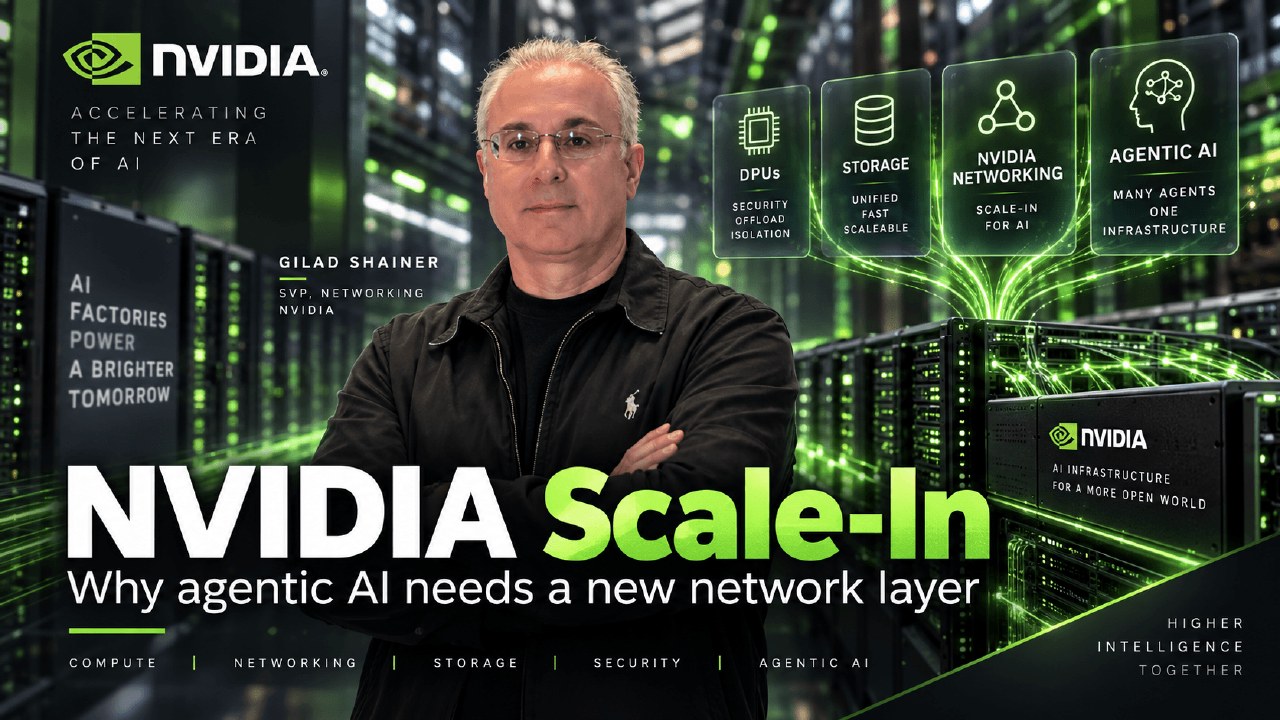
Nvidia is introducing a new network architecture category called scale-in, designed to manage agentic AI workloads. This approach aims to secure and control AI factory resources by extending the role of Data Processing Units (DPUs) beyond simple server access management.
The strategy centers on the BlueField-4 DPU, which integrates a CX-9 SuperNIC and a Grace CPU. It provides an infrastructure-services layer that monitors and enforces security policies independently of the agents themselves, mitigating performance degradation by operating out-of-band.
Nvidia has released OpenShell 0.1.0, an open-source runtime for defining and enforcing agent permissions. It supports frameworks such as Codex, Claude Code, Pi, and Hermes, combining sandboxed execution with credential management and formal policy analysis.
The architecture utilizes DOCA software to program and secure data center infrastructure. By separating infrastructure controls from the agent's application domain, Nvidia aims to ensure that agents remain within defined organizational boundaries while accessing compute, memory, and storage resources.
According to Nvidia, the BlueField-4 architecture increases secure traffic coverage to 7.2 terabits, compared to 400 gigabits in previous paths. This expansion is intended to address the risks associated with multi-step agentic tasks that require repeated model calls and data retrieval.


