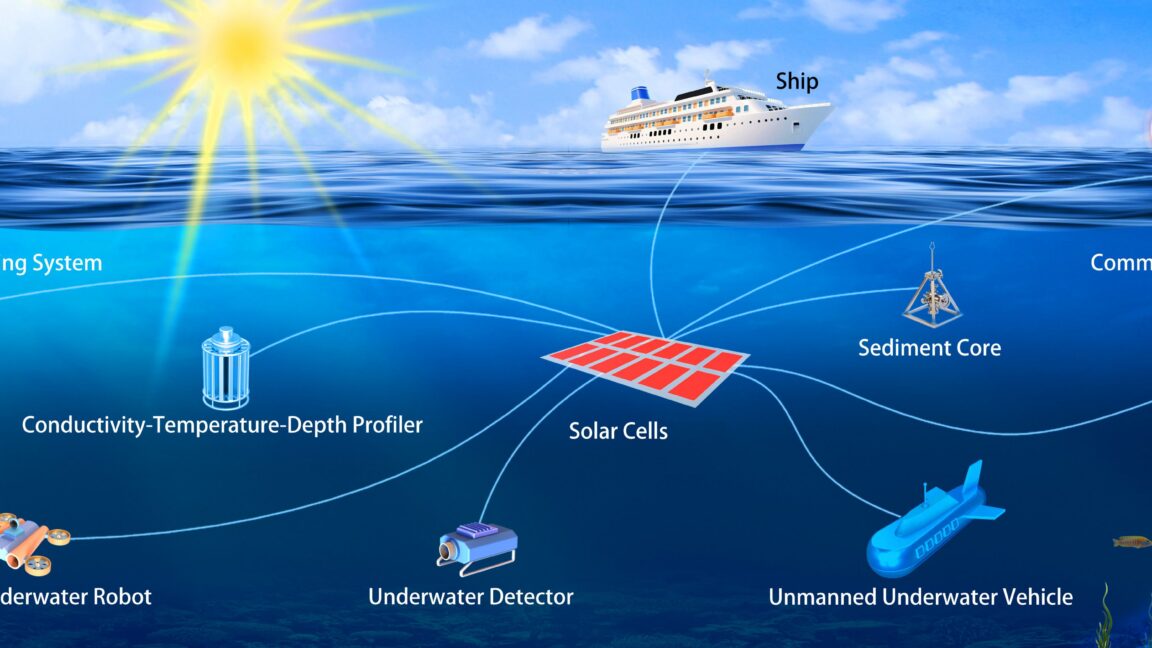
Researchers from Yunnan University and the Southwest United Graduate School have developed a functional underwater solar cell capable of operating at a depth of 10 meters in the South China Sea. The findings were published in the journal Joule on September 11.
Previous attempts at underwater solar energy harvesting were limited to depths of less than two meters. The new device is designed to function in deeper waters, addressing the limitations of earlier technologies that were restricted to shallow environments with high sunlight penetration.
The solar cell can operate underwater for two hours, generating 324 milliwatt-hours of energy, which is sufficient to charge lithium-ion batteries. Under continuous operation at a depth of 10 meters, the device has an estimated lifespan of approximately 5.5 years.
The wide-band-gap perovskite solar cell absorbs light across the spectrum from blue to orange. Tests showed that after 1,160 hours of simulated operation at a depth of 10 meters, the device exhibited almost no performance degradation, demonstrating significant durability.
The team also reported that the solar cell retains about 96 percent of its initial efficiency after being stored in a nitrogen-filled glove box for 300 days. This stability suggests the technology is suitable for long-term deployment in autonomous underwater energy systems.