

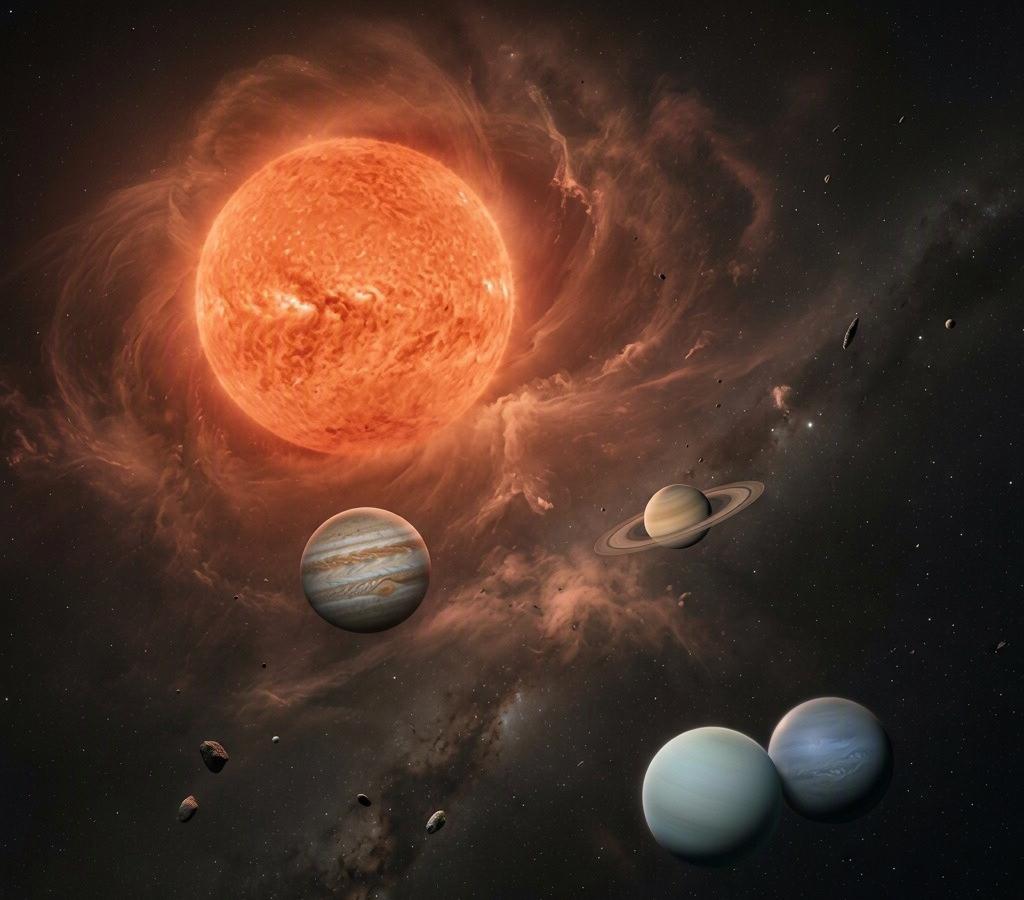
A new study by Konstantin Batygin from Caltech suggests the outer Solar System may become unstable much sooner than previously thought. While earlier models estimated a lifespan of 10¹⁸ years, the new research indicates potential destruction within a billion years after the Sun becomes a white dwarf.
The discrepancy arises from how the Sun loses mass. Previous models assumed a smooth loss, which would expand orbits by 1.85 times while maintaining stability. However, observations of young white dwarfs suggest mass loss occurs through asymmetric ejections, giving the star a recoil velocity of 0.75 km/s.
These individual ejections create random gravitational perturbations. Simulations show that when mass ejections reach 10⁻⁵ of the Sun's mass, planetary orbits begin to shift significantly. In 40% of simulations, the outer system faced destruction or scattering before the white dwarf stage.
Overall, 90% of the modeled systems collapsed within 3 billion years of the white dwarf's formation. This process involves planets scattering, changing positions, or being ejected from the system entirely. Even orbital resonances, such as the 5:2 ratio for Jupiter and Saturn, failed to prevent instability.



