

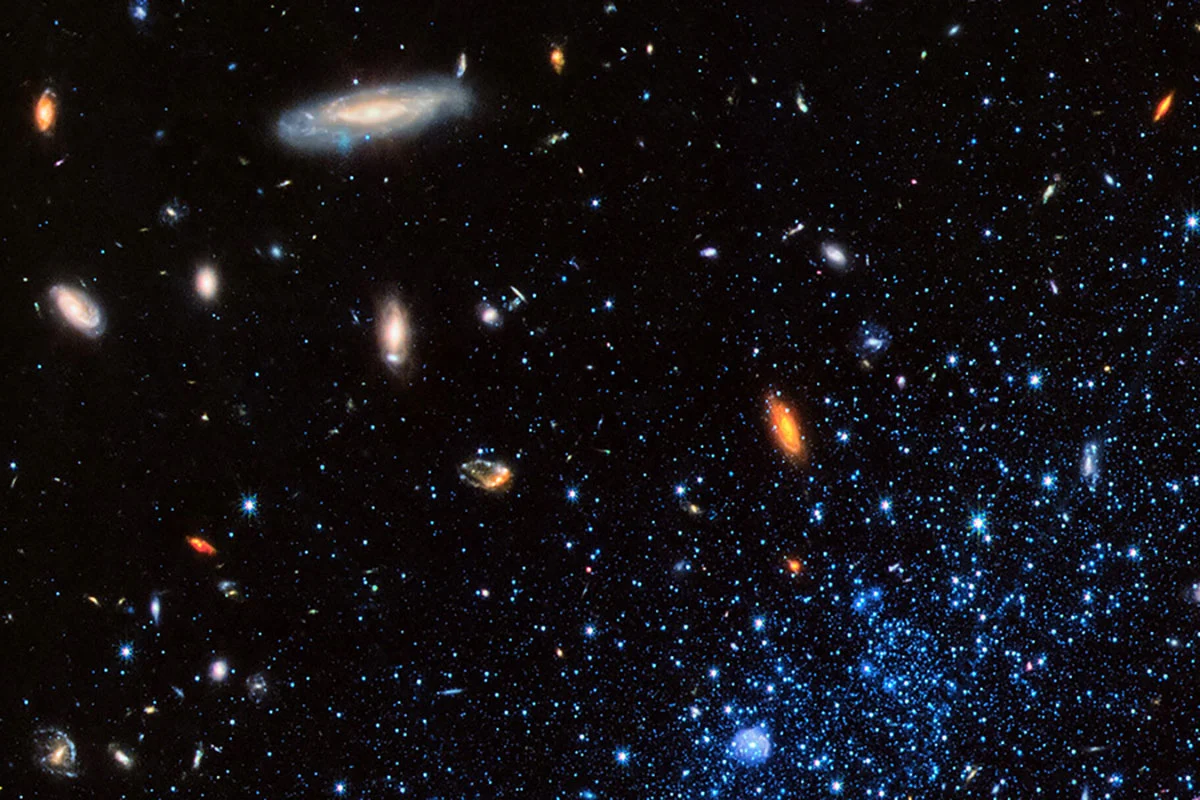
An international team of astrophysicists measured the primordial helium-4 abundance in extremely metal-poor dwarf galaxies. The researchers used high-resolution echelle spectrographs on large optical telescopes in Hawaii to conduct deep-exposure observations of galaxies located hundreds of millions of light-years away.
The team calculated the mass fraction of primordial helium by analyzing fluorescent radiation from ionized helium and hydrogen. They accounted for systematic errors, including interstellar dust extinction and stellar wind interference, to achieve a high-precision measurement accurate to the third decimal place.
The findings align with predictions from the European Space Agency's Planck satellite regarding cosmic microwave background radiation. This consistency between independent observational methods supports the standard Big Bang nucleosynthesis model and confirms current understanding of early universe physical conditions.
Small deviations in the data allow for further research into new physics. The team used the measurements to constrain the number of neutrino species, neutrino asymmetry, and the potential existence of hidden light particles, such as sterile neutrinos or dark radiation.
Experts suggest that future thirty-meter-class optical telescopes will further improve measurement precision. These advancements are expected to help scientists explore physical laws beyond the standard model.



