

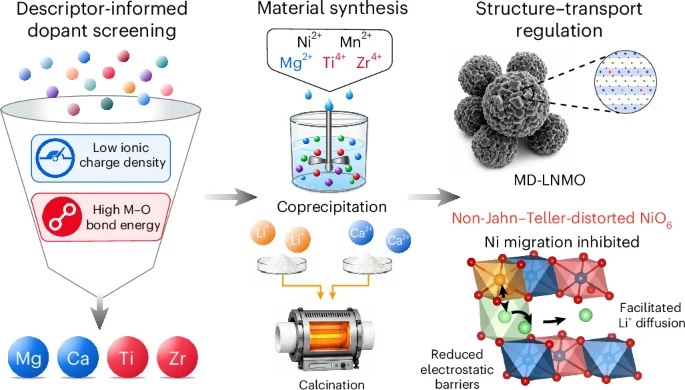
Researchers from the Institute of Metal Research at the Chinese Academy of Sciences have developed a new design strategy for lithium-ion battery cathode materials. The approach focuses on the physical and chemical properties of trace elements to move from trial-and-error methods to goal-oriented development.
The team identified two key mechanisms: elements with low ionic charge density improve lithium-ion mobility, while elements with strong metal-oxygen bonds enhance structural stability. Based on these criteria, researchers selected magnesium, calcium, titanium, and zirconium to create a cobalt-free, high-nickel cathode material.
The new material contains approximately 1% of each selected element. Testing showed that a battery using this cathode can charge to nearly 80% capacity in just 3 minutes. After 350 cycles of rapid charging and discharging at 6-minute intervals, the capacity retention remained at 82.4%.
The 5.74Ah battery prototype demonstrated an energy density of 278.6 Wh/kg at a temperature of -20 degrees Celsius. These findings were published in the international journal Nature Synthesis on October 1, providing a new pathway for developing high-performance batteries for electric vehicles and energy storage.


