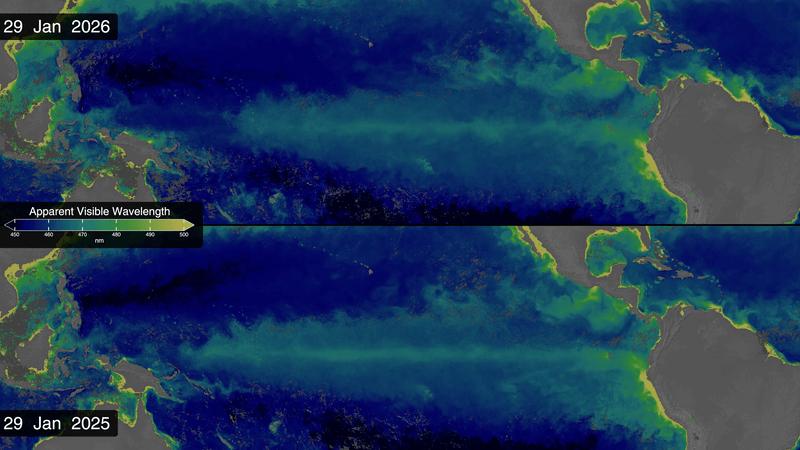
NASA's PACE satellite data indicates a significant reduction in the greenish hue of the Pacific Ocean throughout 2026 compared to 2025. This color shift, particularly noticeable in the central and western regions, signals a decline in phytoplankton populations, which are essential for marine food chains.
The phenomenon is driven by El Nino, which weakens trade winds and prevents nutrient-rich cold water from rising to the surface. This lack of nutrients hinders phytoplankton growth, subsequently impacting the food supply for zooplankton, krill, and larger marine species.
The PACE satellite utilizes the Ocean Color Instrument to measure optical characteristics across hundreds of spectral bands. Researchers use these observations to track changes in phytoplankton composition, as blue tones typically indicate lower concentrations, while green and yellow hues signify higher levels.
According to NOAA reports from October 8, the El Nino event continues to intensify. In certain areas of the eastern equatorial Pacific, surface water temperatures have risen more than 4 degrees Celsius above the historical average.