

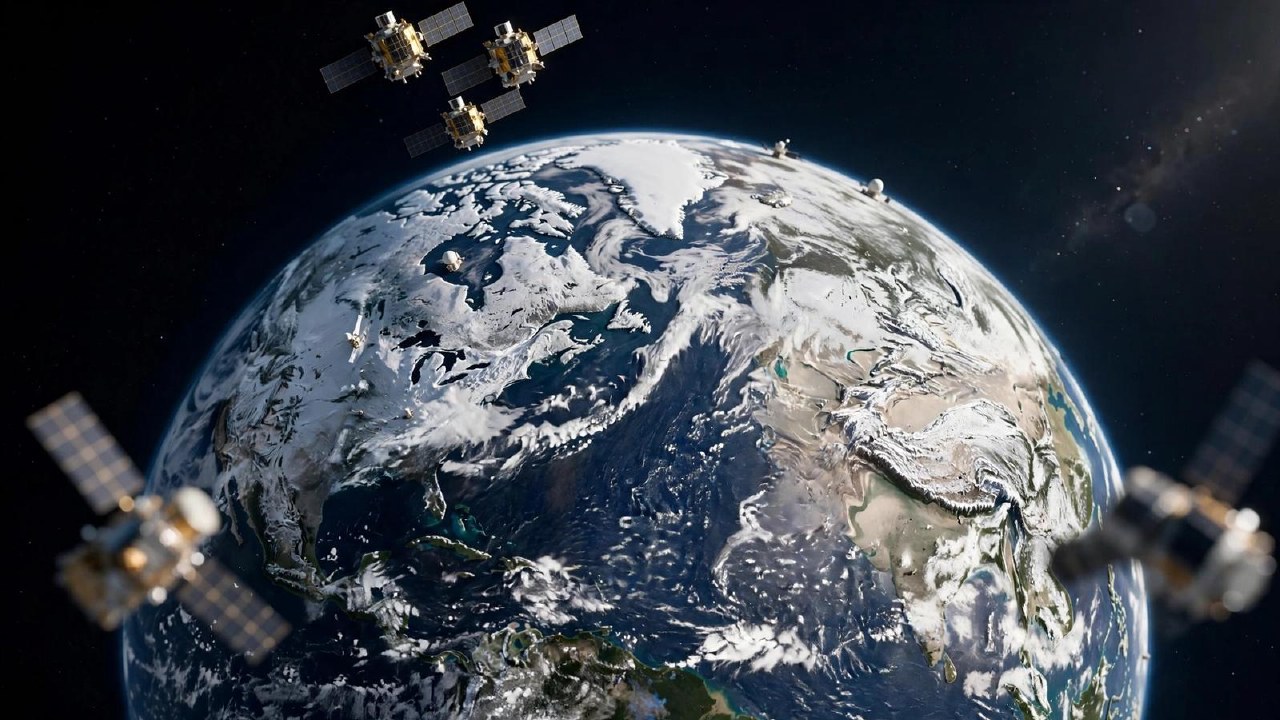
Researchers at NASA's Jet Propulsion Laboratory have introduced a new method to track the seasonal shifting of Earth's center of mass. Previous estimates, published in 2017 and 2023, showed a discrepancy of approximately 7 mm, which is comparable to the seasonal shift itself. This inaccuracy stemmed from assuming that the network of ground-based geodetic stations approximated the planet's geometric center.
The new approach integrates GPS observations with data from low-orbit satellites while accounting for crustal deformations caused by water and ice. This allows scientists to isolate the movement of the center of mass from the displacement of ground stations. The updated assessment indicates that the annual shift is nearly half of what was estimated eight years ago, suggesting that the mass of water and air moving between hemispheres is lower than previously thought.
The methodology links specific seasonal events to these shifts. In March, snow accumulation in North America and Eurasia moves the center nearly 3 mm toward the North Pole. In April, 2400 gigatons of rainfall in the Amazon basin shift it by 2.2 mm toward South America. Additionally, monsoon activity in Southeast Asia in November contributes about 600 gigatons of water to the redistribution, while atmospheric pressure changes in December and June also affect the balance.
These findings were validated using data from the GRACE-FO satellite mission, which measures changes in Earth's gravitational field. By combining these datasets, researchers can now track seasonal changes in continental and atmospheric mass as the movement of a single reference point with millimeter-level precision.



