

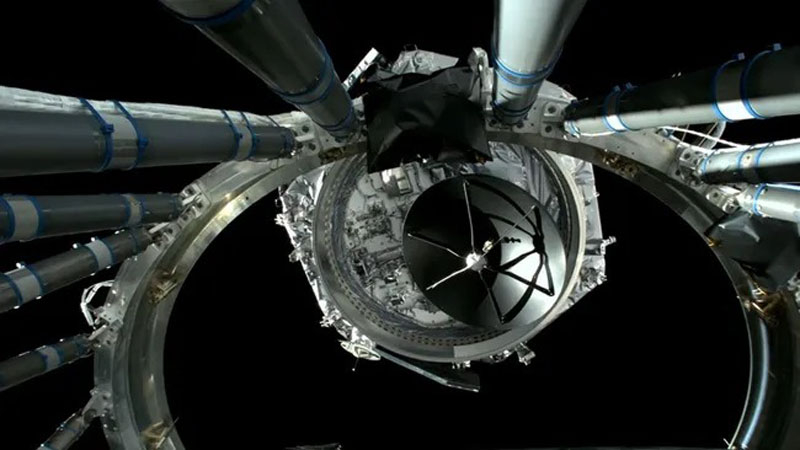
NASA has initiated the activation of onboard systems for the Nancy Grace Roman space telescope, which launched on August 30. The observatory is currently traveling to the Sun-Earth L2 Lagrange point, located approximately 1.5 million kilometers from Earth.
The Wide Field Instrument (WFI) was the first to be activated. This 300-megapixel camera features 18 infrared detectors. Before activation, the sensors underwent a 10-day heating process at -65 degrees Celsius to remove contaminants, followed by cooling to -143 degrees Celsius.
Engineers have successfully captured a test image of a star field to verify the detector functionality and optical systems. While the initial image appears blurred due to ongoing calibration, it serves as a baseline for future adjustments to the telescope's focus and optics.
The team is also testing the Coronagraph Instrument, designed to observe exoplanets by suppressing starlight. Initial checks confirmed the operation of electronic systems, actuators, and software. Full calibration will continue for several months.
NASA expects to receive the first scientific images in early 2027. Due to fuel savings during the launch phase, the mission duration could potentially be extended to 12 years or more, exceeding the original 10-year estimate.



