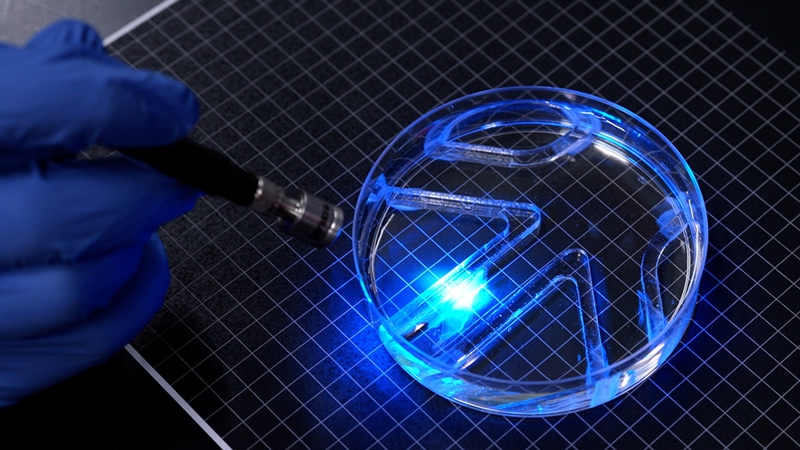
Engineers at MIT have developed a miniature biohybrid robot that utilizes lab-grown skeletal muscle tissue to swim. The device features a flexible hydrogel film base measuring 15 mm in length, 7 mm in width, and 0.5 mm in thickness, equipped with two independently controlled fins.
The muscle tissue, grown on the hydrogel surface, has an effective thickness of less than 15 micrometers. This thin-layer approach is reportedly 20 times more efficient at converting muscle volume into force compared to previous 3D muscle structure designs.
The muscle cells are genetically modified to contract when exposed to light with a wavelength of 470 nm. By adjusting the frequency of light pulses, researchers can control the robot's speed and direction, allowing it to navigate through a simple underwater maze.
Prior to assembly, the muscle tissue underwent training with repetitive light pulses, which increased the contraction amplitude by approximately four times. While the robot can currently maneuver through a water-filled dish, it does not yet operate autonomously.