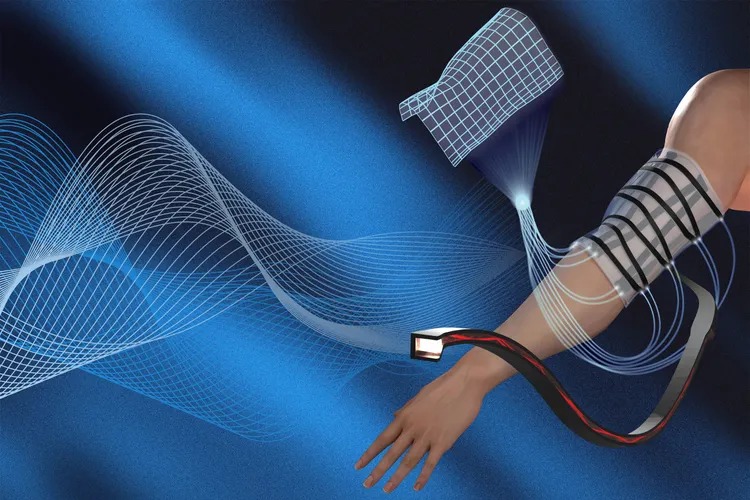
Engineers at MIT have developed a flexible, shape-sensing silicone sheet capable of tracking its own 3D deformations. The device uses an array of 14 flexible rubber optical waveguides embedded in a 16x16x0.5 centimeter silicone base. Each waveguide is 160 millimeters long and equipped with an LED light source and a sensor to measure light loss, which indicates the degree and direction of bending.
The system processes data via an external circuit board, with 3D reconstruction performed in MATLAB at a rate of approximately 3 times per second. Laboratory tests demonstrated a reconstruction error of less than 0.5 centimeters. The prototype maintains functionality even if some waveguides are damaged; simulations show that with up to 3 failed waveguides, the error remains under 0.3 centimeters.
The technology is designed for applications in virtual reality, gaming, and physical rehabilitation, where it could help therapists quantify patient progress. Researchers are currently working to reduce the thickness of the 1-millimeter optical fibers to tens of microns, aiming to eventually integrate the technology into smart clothing and improve the system's overall performance and detail.
The study, titled 'Fully Flexible Multifunctional Shape Sensing via Optical Waveguide Arrays,' was published in the journal Advanced Intelligent Systems. Future development plans include replacing the MATLAB solver with faster algorithms, increasing the number of waveguide layers, and creating devices that can simultaneously measure both pressure and shape.