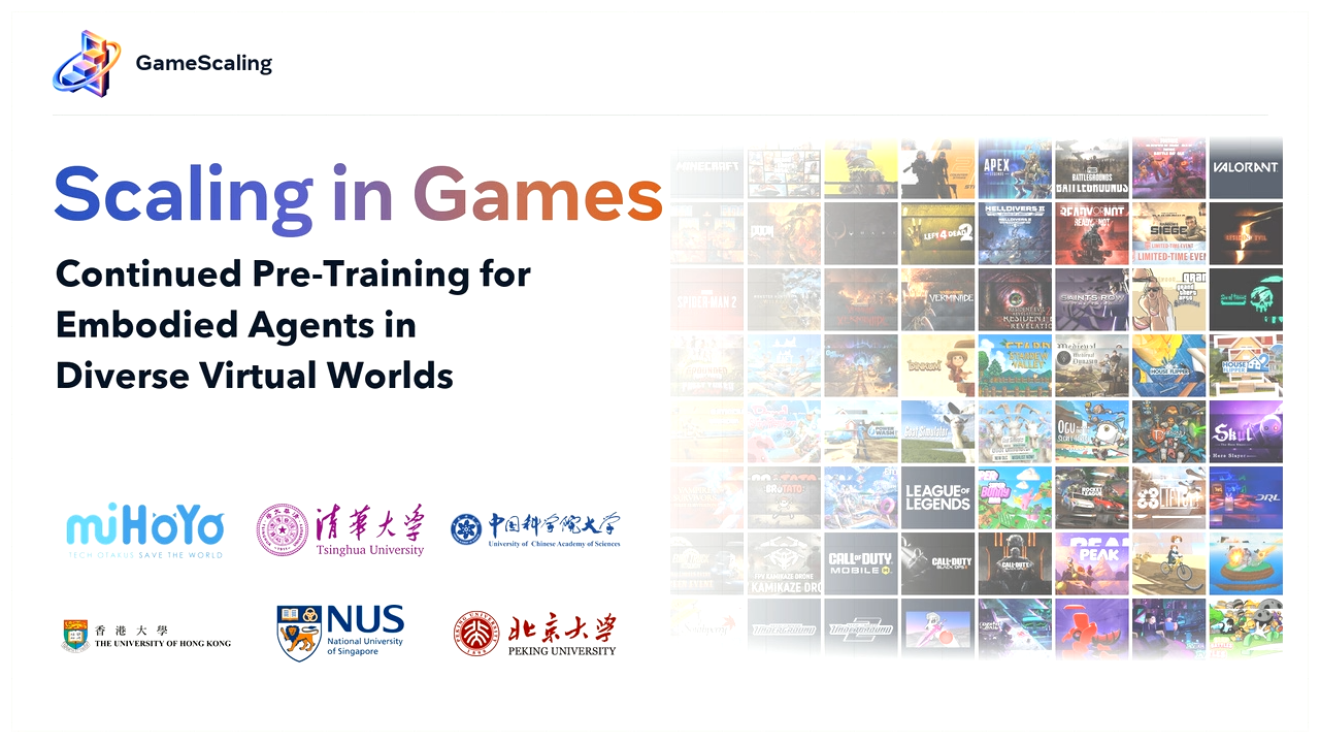
The GameScaling project, developed by miHoYo's Honkai AI team in collaboration with institutions including Tsinghua University and Peking University, has been released as an open-source initiative. The project introduces eight model checkpoints ranging from 0.8B to 27B parameters, built upon the Qwen3.5 vision-language model.
These models are trained on 1600 hours of gameplay data involving keyboard and mouse inputs. They process current and previous game frames to generate control commands. The S1 versions are trained exclusively on Minecraft data, while S3 versions utilize a multi-game dataset where Minecraft accounts for 27 percent of the input.
The models are designed for real-time interaction, generating operation sequences covering approximately 200 milliseconds per call, consisting of six 33-millisecond steps. Deployment requirements vary: the 0.8B, 2B, and 9B versions run on a single GPU, whereas the 27B version requires two GPUs for tensor parallel inference.
The project supports vLLM for service deployment and provides inference clients, prompt templates, and parsing code. All components, including model weights and source code, are released under the Apache 2.0 license. Detailed research findings are documented in the paper titled Scaling in Games: Continued Pre-Training for Embodied Agents in Diverse Virtual Worlds.