

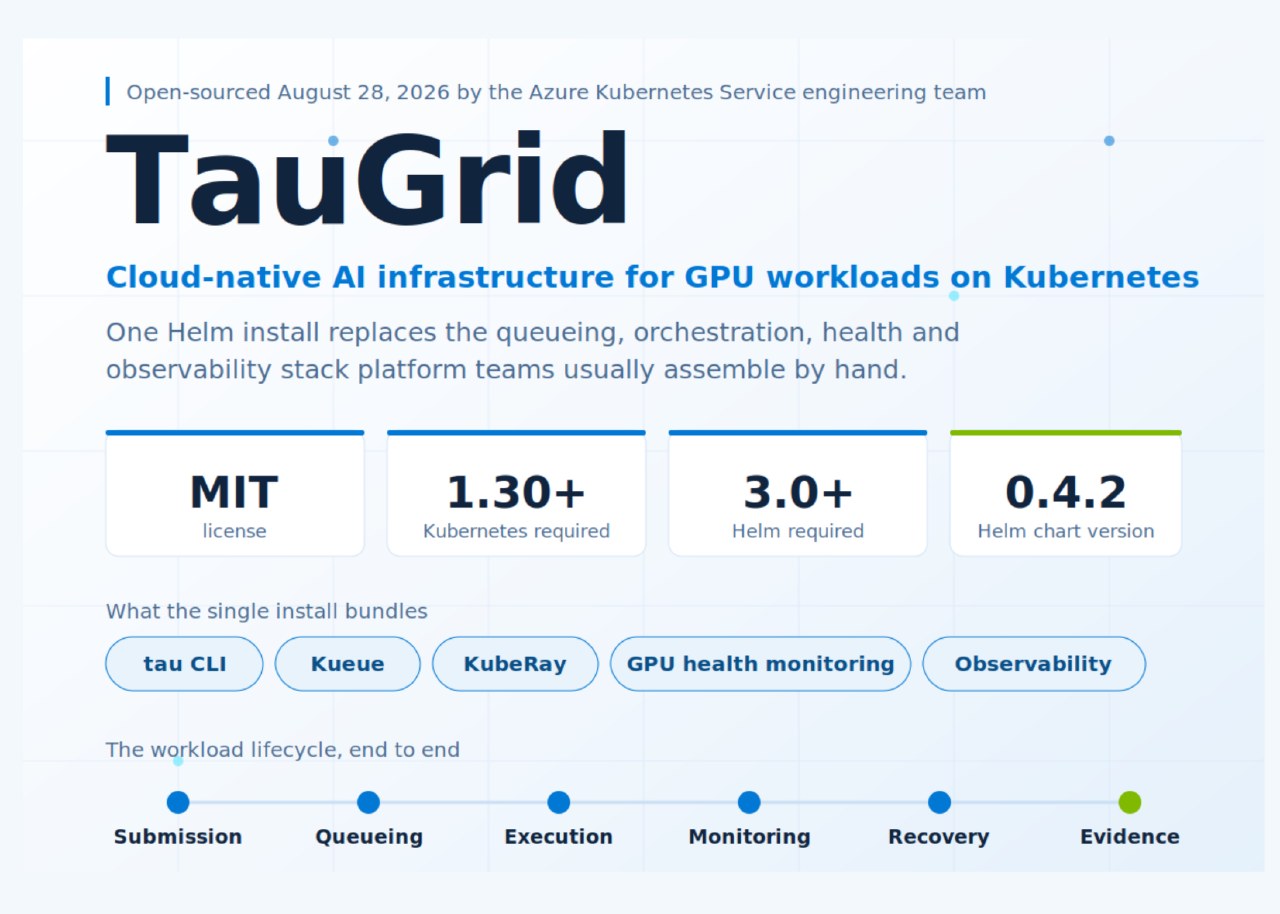
Microsoft has released TauGrid, an open-source platform designed for managing AI workloads on Kubernetes. The project is distributed under the MIT license, with container images and Helm charts available via the Microsoft Container Registry. The system requires a Kubernetes 1.30+ cluster equipped with GPU nodes, along with kubectl and Helm 3.0 or newer.
The platform integrates several components, including the tau CLI, Kueue for workload queuing, and KubeRay for cluster orchestration. It also provides monitoring for GPU health and cluster observability. The codebase is primarily written in Go, allowing platform teams to manage compute profiles and storage while researchers submit jobs via a repository and the CLI.
Workloads are defined using a tau.yaml file, which specifies compute requirements and runtime environments. The system processes these files through six stages: submission, queueing, execution, monitoring, recovery, and evidence. The recovery phase includes retry mechanisms and checkpointing, while the evidence stage records metadata and logs for auditability.
TauGrid supports multi-tenant environments by using Kueue to manage job quotas and priorities across shared clusters. While the platform is designed to operate independently of Azure, some features like observability currently rely on Azure Data Explorer. Microsoft states that it does not collect telemetry by default and encourages community contributions to improve support for non-Azure environments.



