

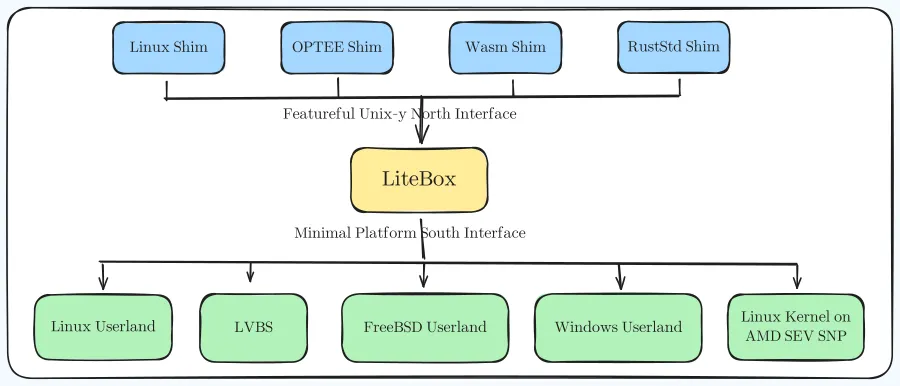
Microsoft has officially released LiteBox 0.1, the first version of its open-source Library OS project. The initiative, developed by Microsoft engineers and contributors, focuses on building a lightweight sandbox isolation layer for applications using the Rust programming language and Linux virtualization security technologies.
Unlike traditional operating systems, LiteBox acts as a security layer between applications and the host kernel. It leverages hardware-assisted virtualization to create restricted execution environments. By utilizing Rust, the project aims to minimize memory-related vulnerabilities such as buffer overflows and use-after-free errors, which are critical for low-level security components.
The architecture is designed as a Library OS, providing only essential system components required by an application to reduce the overall attack surface. Microsoft envisions LiteBox supporting isolated execution of Linux applications on both Linux and Windows platforms, addressing security risks associated with untrusted code or AI-generated software.
LiteBox 0.1 is currently in an early development stage. Microsoft has not yet provided detailed release notes, noting that future updates will include comprehensive changelogs. The release serves primarily to confirm that the project remains active and has transitioned into a formal versioning cycle, rather than indicating production-ready status.
While LiteBox aligns with industry trends toward improved memory safety and reduced attack surfaces, it is not yet intended to replace mature sandbox technologies like Docker or standard virtual machines. Its performance, compatibility, and security boundaries remain subject to further validation in upcoming development cycles.



