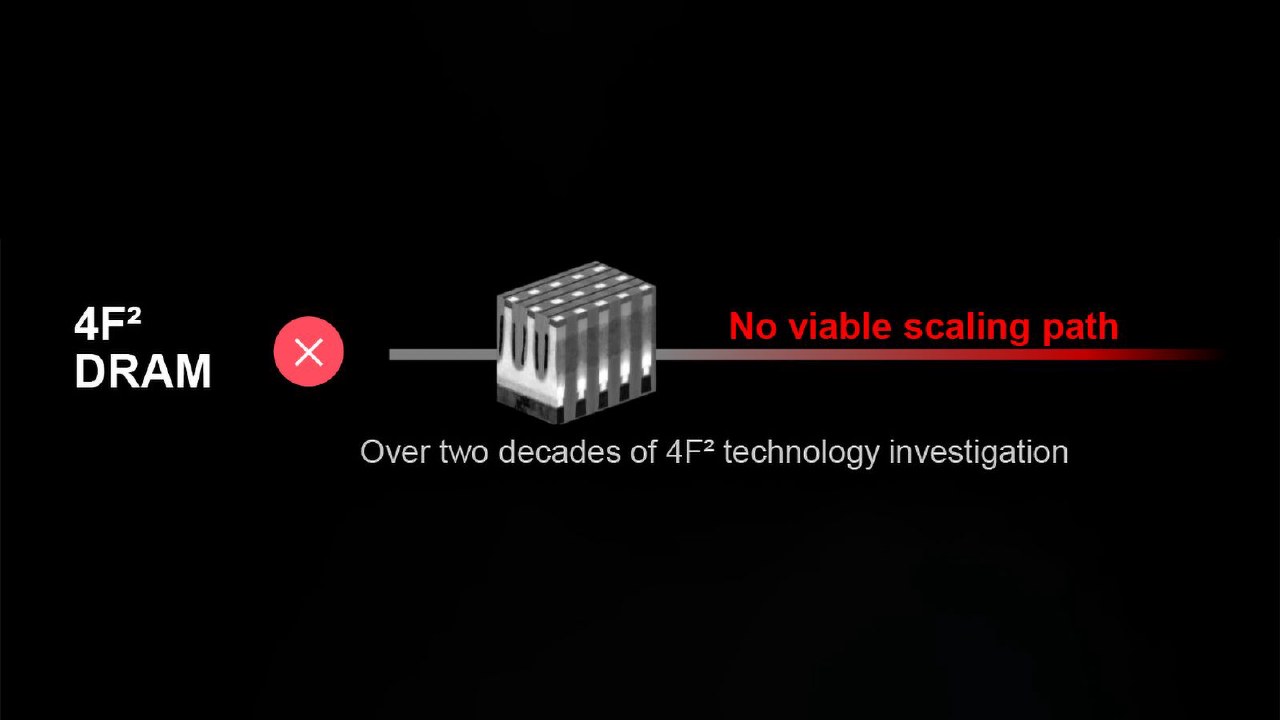
Micron has officially abandoned the development of 4F² DRAM architecture after two decades of internal research. The company concluded that the technology fails to provide meaningful density advantages compared to the current 6F² standard while simultaneously increasing manufacturing complexity and costs.
According to Scott DeBoer, Micron's chief technology officer, the actual bit density of DRAM is determined by capacitor pitch and dimensions rather than the nominal area of the transistor. Micron maintains that the 4F² architecture faces fundamental scaling limitations that make it less efficient than continuing to refine 6F² processes.
Micron plans to focus on scaling conventional 6F² DRAM through advanced lithography, new materials, and wafer bonding. The company's 1δ process technology is scheduled for volume production in the second half of 2027 and is expected to deliver a mid-20% improvement in bit density.
While competitors like Samsung and SK hynix continue to include 4F² cells in their roadmaps, Micron is prioritizing the transition to 3D DRAM. The company is currently developing multiple generations of 3D DRAM nodes, which involve stacking memory cells vertically to improve density as planar scaling reaches its physical limits.