

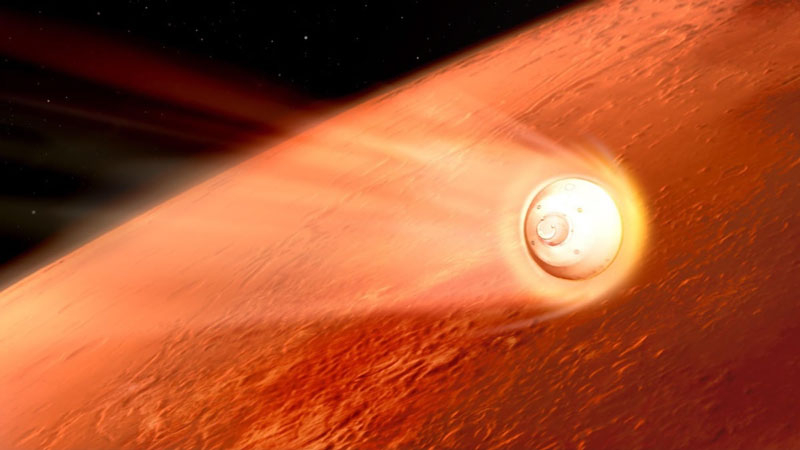
In 2021, during the landing of the Perseverance rover, components of the descent module impacted the Martian surface. Two tungsten ballast weights, each weighing 77 kg, and a cruise stage fragment weighing approximately 540 kg struck the ground at a speed of 4.7 km/s.
The impact occurred at a shallow angle of 10 degrees, approximately 70 km northwest of the Jezero crater. This event created five distinct craters, which were identified using images from the Mars Reconnaissance Orbiter by comparing them with earlier surface data.
Researchers utilized the known mass of the impactors to refine crater formation models for Mars. Analysis of the crater dimensions and debris patterns, combined with 3D modeling, allowed scientists to estimate the mechanical properties of the local soil.
The study determined the soil cohesion to be approximately 7 kPa, indicating a loose, sand-like material. This finding suggests the Martian surface in that region is twice as soft as previous models predicted, aligning with earlier observations from the InSight lander.



