

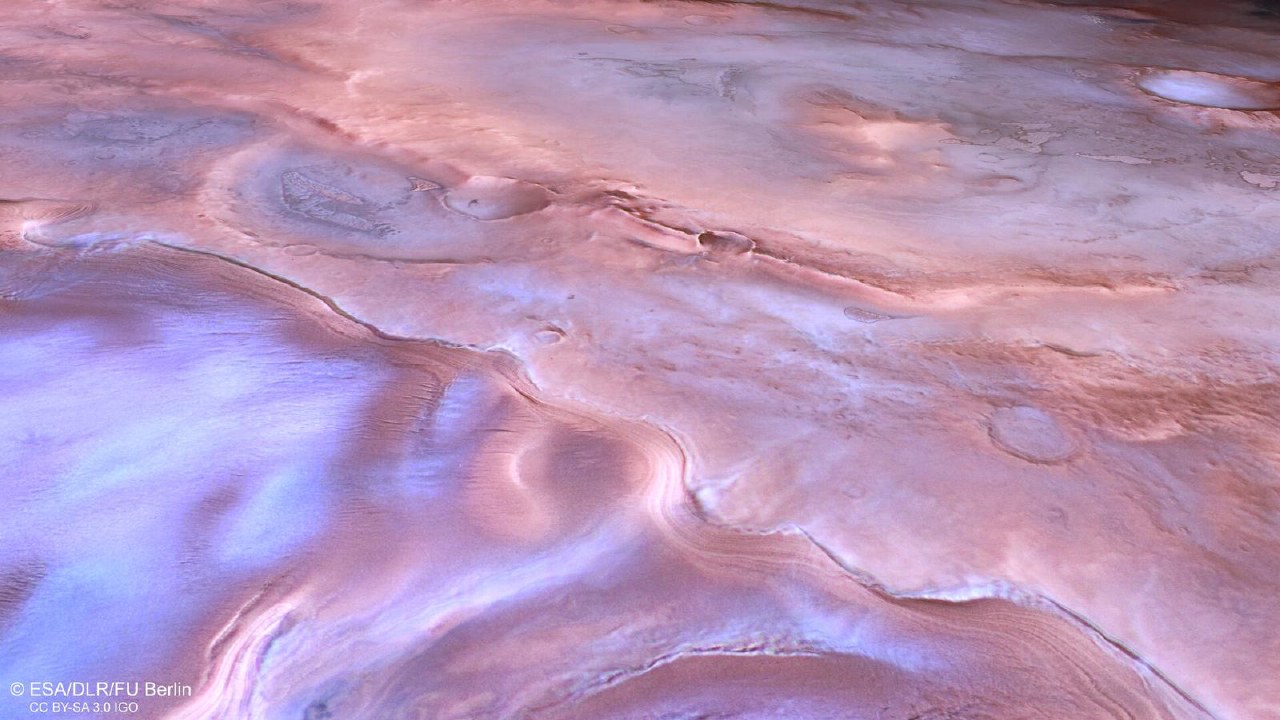
The High Resolution Stereo Camera (HRSC) on the Mars Express orbiter captured images of a rocky, icy region near the Martian south pole. The terrain features cliffs rising over 1 km in height, with a system of scarps extending for hundreds of kilometers across the southern highlands.
The observed purple and pink hues result from a combination of morning light, atmospheric dust, and frost on the surface. Darker areas of the Thyles Rupes scarp contain volcanic material rich in mafic minerals, specifically olivine and pyroxene. Lighter regions feature frozen carbon dioxide deposits, which persist through the spring.
The Thyles Rupes scarp likely formed due to tectonic activity billions of years ago, when the cooling of the planet's interior caused the crust to contract and deform. The region also displays various sand dune patterns created by shifting winds. A portion of the southern polar ice cap is visible in the lower left of the frame.
Mars Express has been operating in orbit since 2003, mapping the planet in color and 3D. The mission has documented a diverse surface composition, including volcanic sands, clays, sulfates, and ice deposits, which contrast with the planet's typical iron-oxide-dominated red-brown landscape.



