

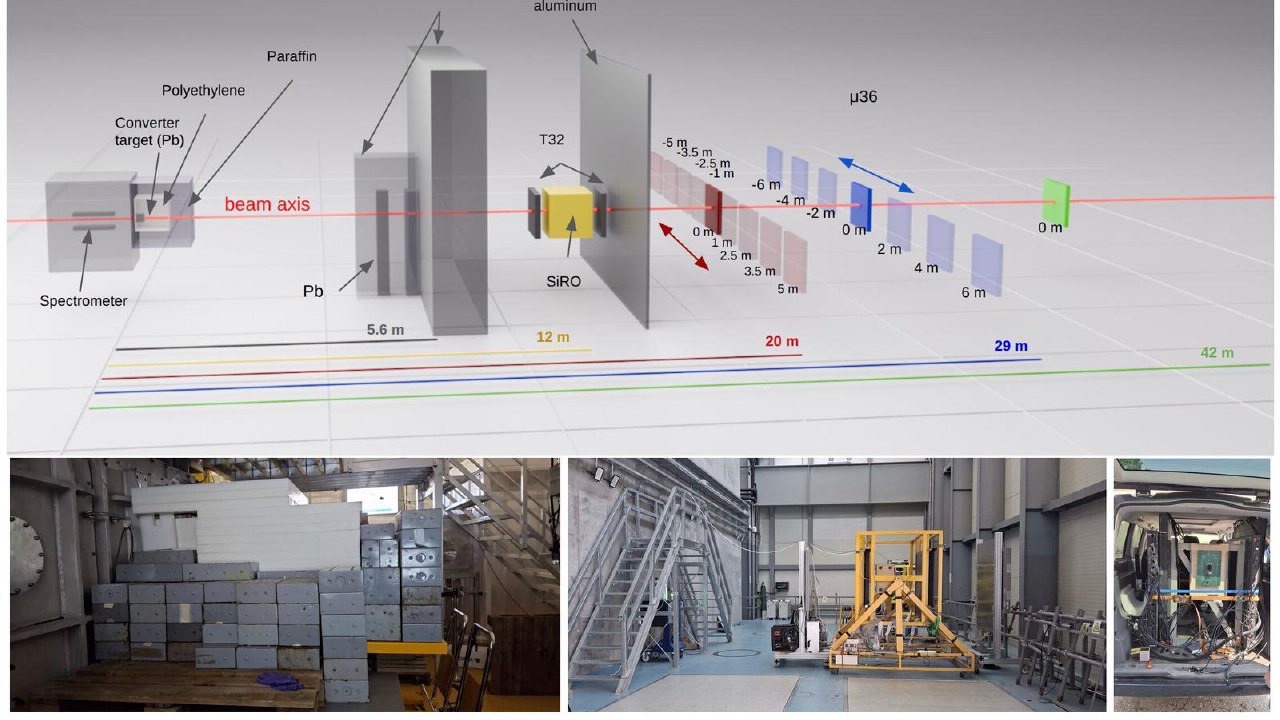
An international research team successfully captured an image of an object using an artificial muon beam generated by a high-power laser. The experiment took place at the Extreme Light Infrastructure Nuclear Physics facility in Romania.
Muons are particles approximately 200 times heavier than electrons, allowing them to penetrate dense materials like metal and rock. Traditional muography relies on natural cosmic rays, which provide a low flux of about one particle per square centimeter per second, often requiring months for detailed imaging.
To create an artificial source, researchers used a high-power laser to accelerate electrons in gas, which then collided with a solid target to produce muon pairs. A plastic and paraffin filter was used to isolate the muons from other particles.
Detectors positioned up to 42 meters away successfully imaged a stack of lead bricks through a two-meter-thick concrete wall. Computer simulations confirmed that approximately 90% of the detected particles were muons.
While current image resolution is low, the team plans to improve laser and detector technology. This method could eventually enable rapid, on-demand scanning of large infrastructure like bridges and buildings, as well as the detection of hidden nuclear materials.


