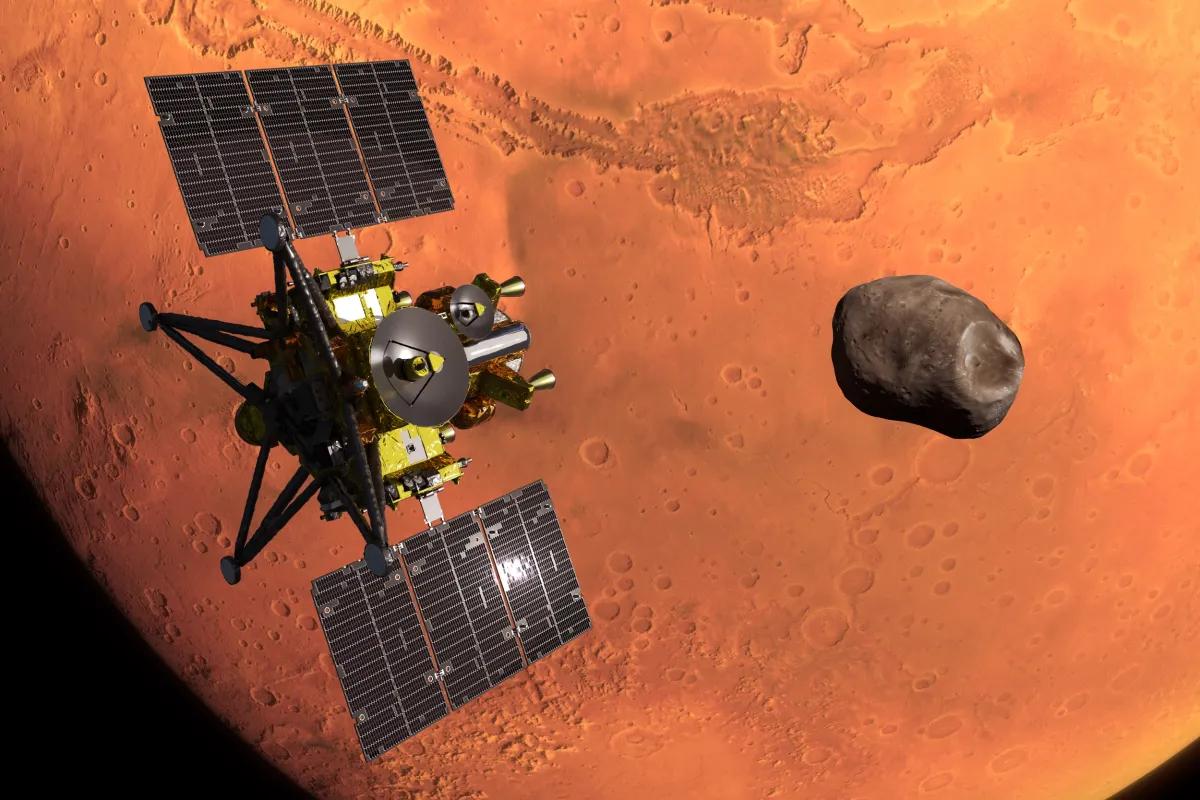
The Martian Moons Exploration (MMX) mission, led by the Japan Aerospace Exploration Agency (JAXA), has launched with the goal of retrieving samples from Phobos. The spacecraft is tasked with collecting at least 10 grams of material from the Martian moon and returning it to Earth by 2031.
The MMX probe comprises three modules: a propulsion unit, a research module for sample collection, and a return capsule. In early 2029, a small rover will land on Phobos for a 100-day mission to identify a landing site for the main craft. The primary collection phase is scheduled to last approximately 2.5 hours.
The spacecraft is equipped with two sampling systems: the C-sampler, designed to extract material from a depth of 2 centimeters, and the P-sampler, which utilizes nitrogen pulses to collect dust and small rocks. Additionally, the probe carries 13 scientific instruments, including cameras, a laser altimeter, a spectrometer, and a chemical detector.
The mission aims to determine the origin of Phobos, testing hypotheses that it is either a captured asteroid or a body formed from impact debris. Researchers also hope to identify Martian rock particles deposited on the moon over billions of years. The European Space Agency (ESA) provided equipment for deep-space communications.
Upon completing the collection, the MMX will depart for Earth. The return capsule is expected to land in Australia via parachute, after which it will be transported to Japan for laboratory analysis. Scientists intend to use advanced terrestrial equipment to study the samples and refine models of the solar system's evolution.