The Commission for Regulation of Utilities in Ireland has released its first national assessment of grid flexibility requirements. The report estimates a need for 234 MW and 58 GWh of upward flexibility on distribution networks by 2028. These requirements can be addressed through managed electric vehicle charging, industrial demand response, and battery storage systems.
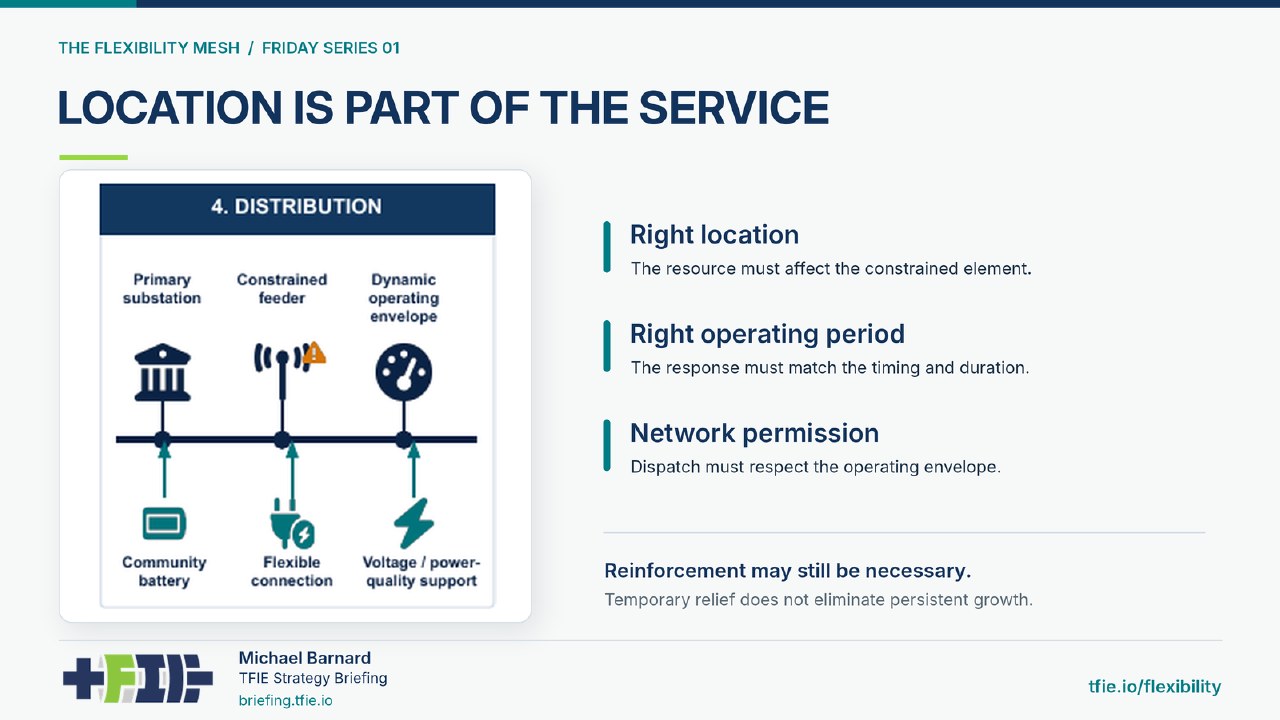
The assessment highlights that grid needs are highly localized. For instance, the Naas 38 kV/10 kV substation is modeled to require 0.6 MW and 3 MWh of flexibility in 2028, specifically during January. However, the regulator plans network reinforcement by 2030, after which the flexibility requirement is expected to be eliminated. These figures represent modeled needs rather than firm procurement commitments.
Effective grid management depends on the electrical location of resources. A battery or demand response asset must be positioned to influence power flows at the specific constrained equipment. National capacity estimates are insufficient for investment decisions, as demonstrated by the UK Power Networks experience in March 2026, where tenders were halted for substations with 24-hour constraints.
The analysis is part of a broader strategy report titled The Flexibility Mesh, which outlines how physical assets and commercial frameworks interact. The report emphasizes that as electric vehicles and heat pumps increase load, utilities must move beyond national capacity estimates toward location-specific evidence to determine whether to procure flexibility services or pursue physical infrastructure upgrades.