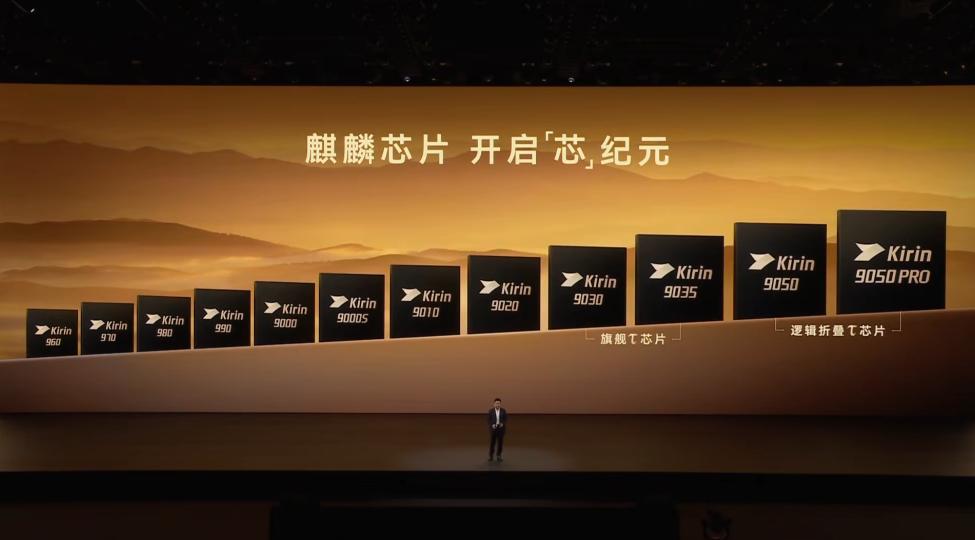
Huawei has unveiled its new Kirin 9050 Pro processor, which the company claims is its most powerful chip to date. The hardware utilizes 3D logic element reconstruction to increase component density without expanding the die size. This architecture achieves a transistor density of 238 million per square millimeter, marking a 28% increase over previous generations.
The Kirin 9050 Pro features a 9-core CPU configuration with clock speeds reaching 3.1 GHz. It supports an inter-chip bandwidth of 125 TB/s and reduces critical path latency by 30%. The chip also integrates the Ma Liang 955 GPU, which delivers a 40% improvement in rendering performance, and a Da Vinci-based NPU that boosts AI computing capabilities by 140%.
The new flagship lineup includes the Kirin 9030 for the standard Mate 90 and the Kirin 9035 for the Mate 90 Pro. Compared to the previous generation, the Mate 90 series shows performance gains ranging from 20% to 31% depending on the model. The Kirin 9035 offers an 11% increase in CPU performance and a 51% boost in NPU efficiency compared to the Kirin 9030 Pro.
The 9050 Pro chip incorporates a 30-bit hybrid MoE architecture, designed to run large AI models directly on the device. Additionally, the tenth-generation ISP enhances telephoto lens resolution by 34%. These technical advancements allow the chip to maintain high performance while reducing clock buffer requirements by 55%.