At the 2026 Apsara Conference, H3C introduced a shift in AI infrastructure strategy, prioritizing system-level optimization and token efficiency over simple GPU scaling. The company argues that as clusters grow to thousands of units, performance depends on the coordination of networking, storage, and software rather than just raw chip count.
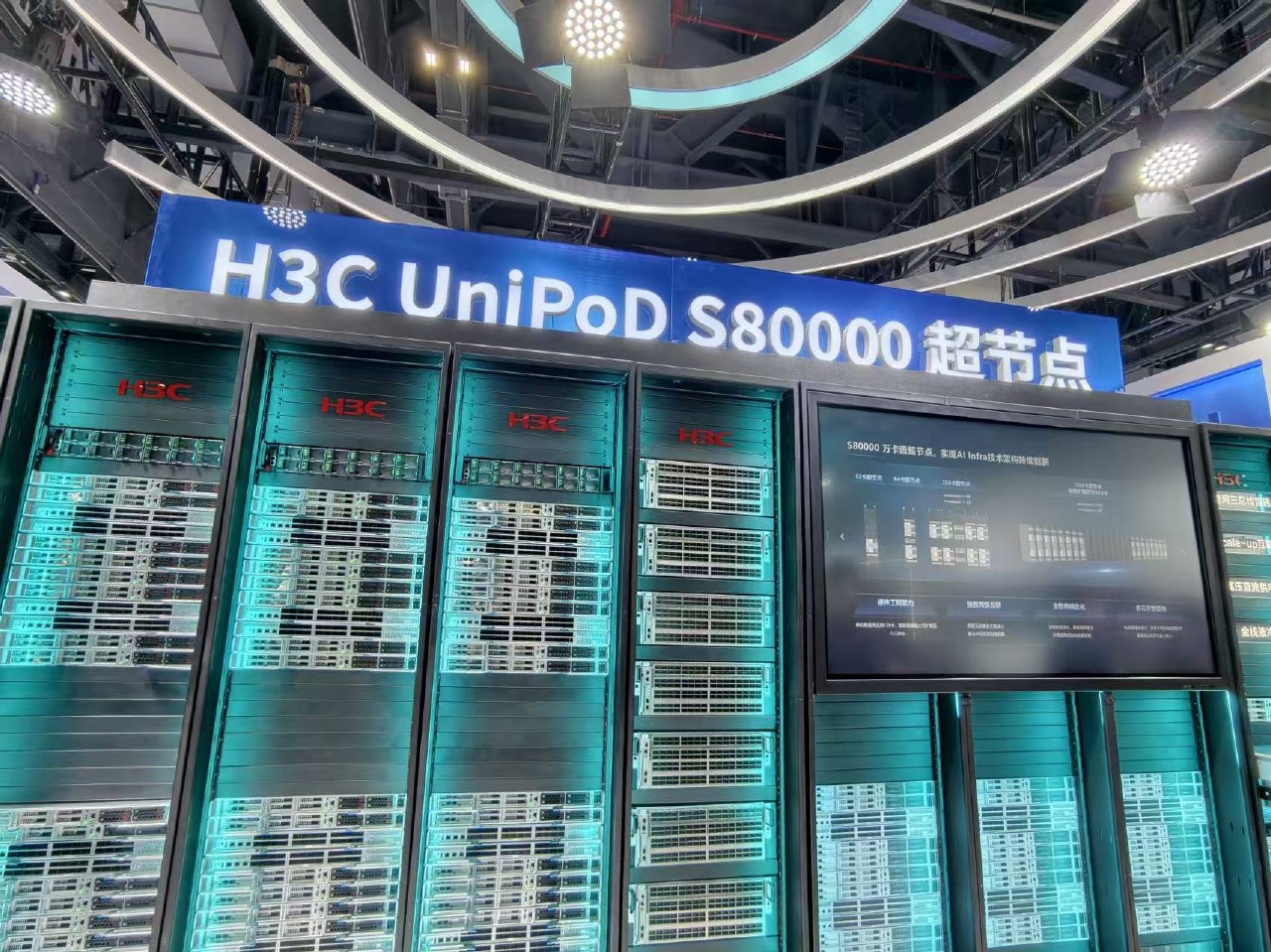
The new UniPoD S80000 Series SuperPod supports configurations from 32 to 1,024 GPUs, with scalability up to 16,384 units. It integrates heterogeneous resources, including CPUs, NPUs, and DPUs. H3C emphasizes that managing these as a unified system is critical to reducing GPU idle time and improving overall compute utilization.
H3C unveiled three networking solutions: the S9828-128EO switch for intra-node communication, which reduces latency by 15% using co-packaged optics; the 1.6T S9828-64FP switch for inter-node connectivity, cutting power consumption by over 20%; and the 800G S12500R-64EP switch for data center interconnects.
To address data bottlenecks, the UniStor X20000 series X20836 storage system offers 200GB/s bandwidth and 3 million IOPS per node. H3C claims its full-speed engine reduces GPU wait times by 30%, while XCache inference acceleration can lower time-to-first-token latency by up to 90%.