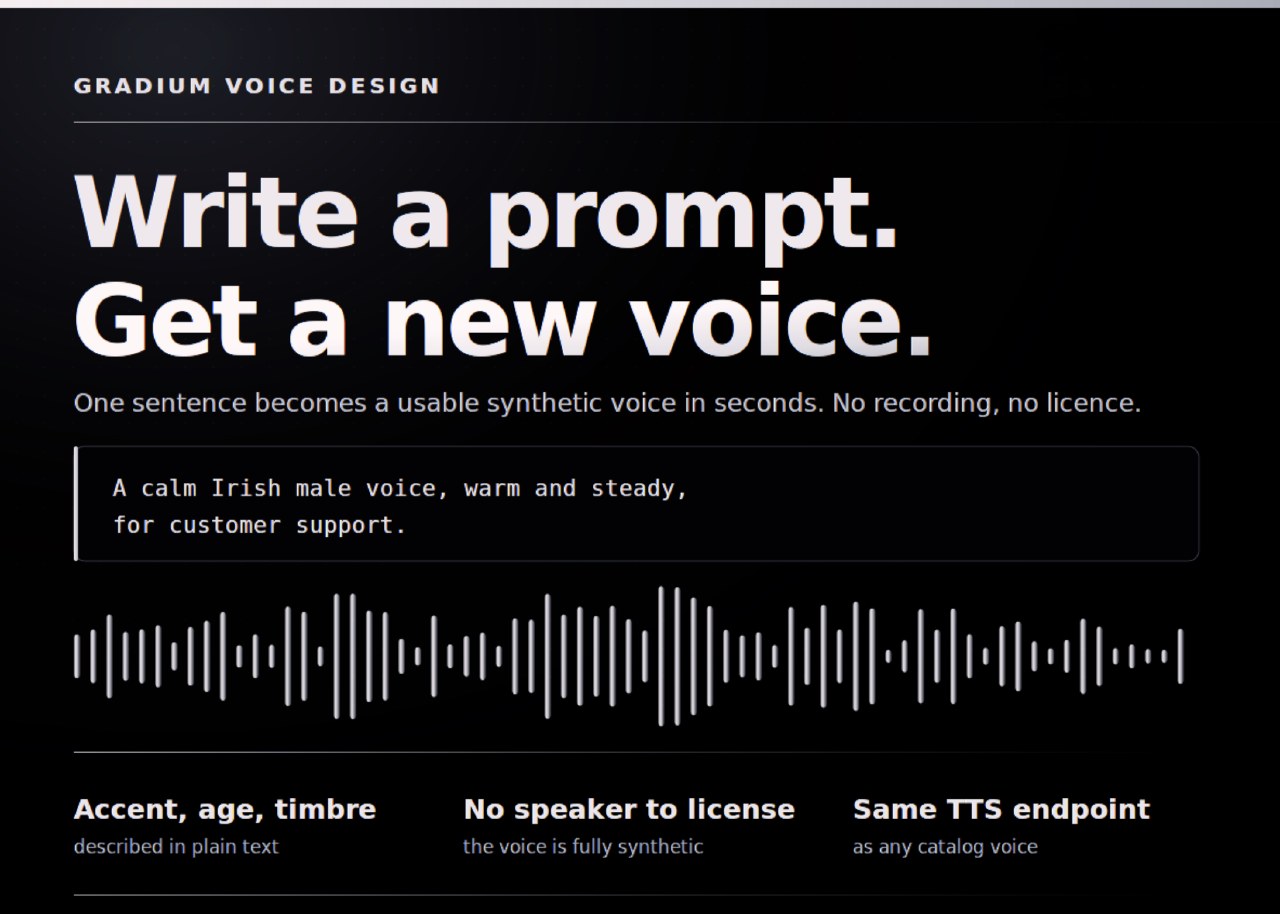
Voice Design allows users to create synthetic voices using only text descriptions, eliminating the need for reference audio or speaker rights. The tool is available via the Gradium API and Studio, including on the free tier. Generated voices use the same streaming Text-to-Speech endpoint as catalog voices, maintaining identical latency and output formats.
The model accepts descriptions from 1 to 500 characters in English, French, Spanish, Portuguese, and German. It responds to attributes such as gender, age, accent, pitch, pace, energy, timbre, and intended use. A single request typically produces 1 to 5 candidates within 3 to 5 seconds.
The technical workflow involves four API calls to generate candidate IDs, poll for readiness, audition voices via the TTS endpoint, and promote a selected voice. Candidates have restrictions: audition text is limited to 100 characters, they are REST-only, and are deleted after 30 days unless converted. Conversion is free and uses a custom voice slot; free plans allow 5 slots, while paid plans provide 1,000.
Gradium reports a 72.6% win rate in a blind pairwise listening test across five languages and 7,627 comparisons, surpassing ElevenLabs (59.0%), Inworld (44.8%), Fish Audio (36.7%), and MiniMax (31.7%). The highest win rates were seen in regional accents, including Quebecois French (97%), Rioplatense Spanish (86%), and Bavarian German (85%).
A model judge, Gemini 3.1 Pro, confirmed these rankings with Gradium scoring 4.06 and ElevenLabs 3.86. Additionally, the company claims 83.4% prompt adherence on the English split of the InstructTTSEval academic benchmark.