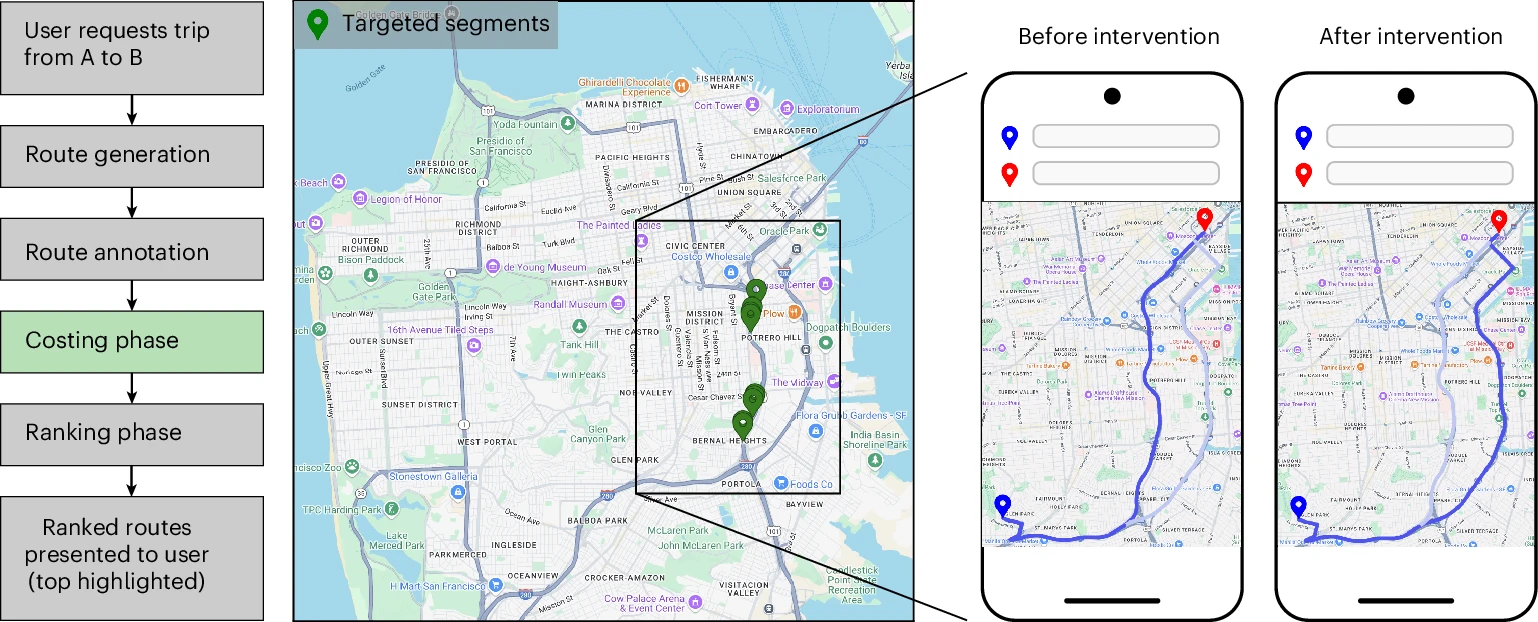
Google researchers conducted a six-month traffic experiment across 10 US cities, including San Francisco, Los Angeles, and Seattle. By intentionally routing a small portion of drivers away from congested main roads to alternative paths, the team aimed to optimize overall traffic flow rather than prioritizing the fastest route for every individual user.
The study, published in the journal Nature Cities, focused on approximately 100 road segments per city prone to bottlenecks. In San Francisco, for instance, drivers were redirected from Highway 101 to Interstate 280. While redirected drivers spent slightly more time on the road, those remaining on the primary route saved about 30 seconds, improving overall traffic efficiency.
Results showed an average 2% increase in speed and a 0.7% reduction in travel time on the affected segments. In cities like Los Angeles, speed improvements reached 4.6%. Researchers noted that reducing vehicle density on roads near capacity significantly prevents gridlock, though they cautioned that excessive diversion could trigger 'induced demand' where more people choose to drive.
The study estimates that long-term implementation of this strategy could reduce carbon dioxide emissions by approximately 1,000 metric tons annually. Despite the potential benefits, the experiment has sparked discussions regarding the influence of navigation platforms on urban traffic and the need for collaboration between tech companies and local governments.
Legislative efforts are already underway, such as California's Bill 2015, which seeks to study the impact of navigation apps on state infrastructure. Meanwhile, urban planners emphasize that while algorithmic routing helps, long-term solutions for congestion require broader strategies like public transit, cycling, and reduced overall vehicle dependency.