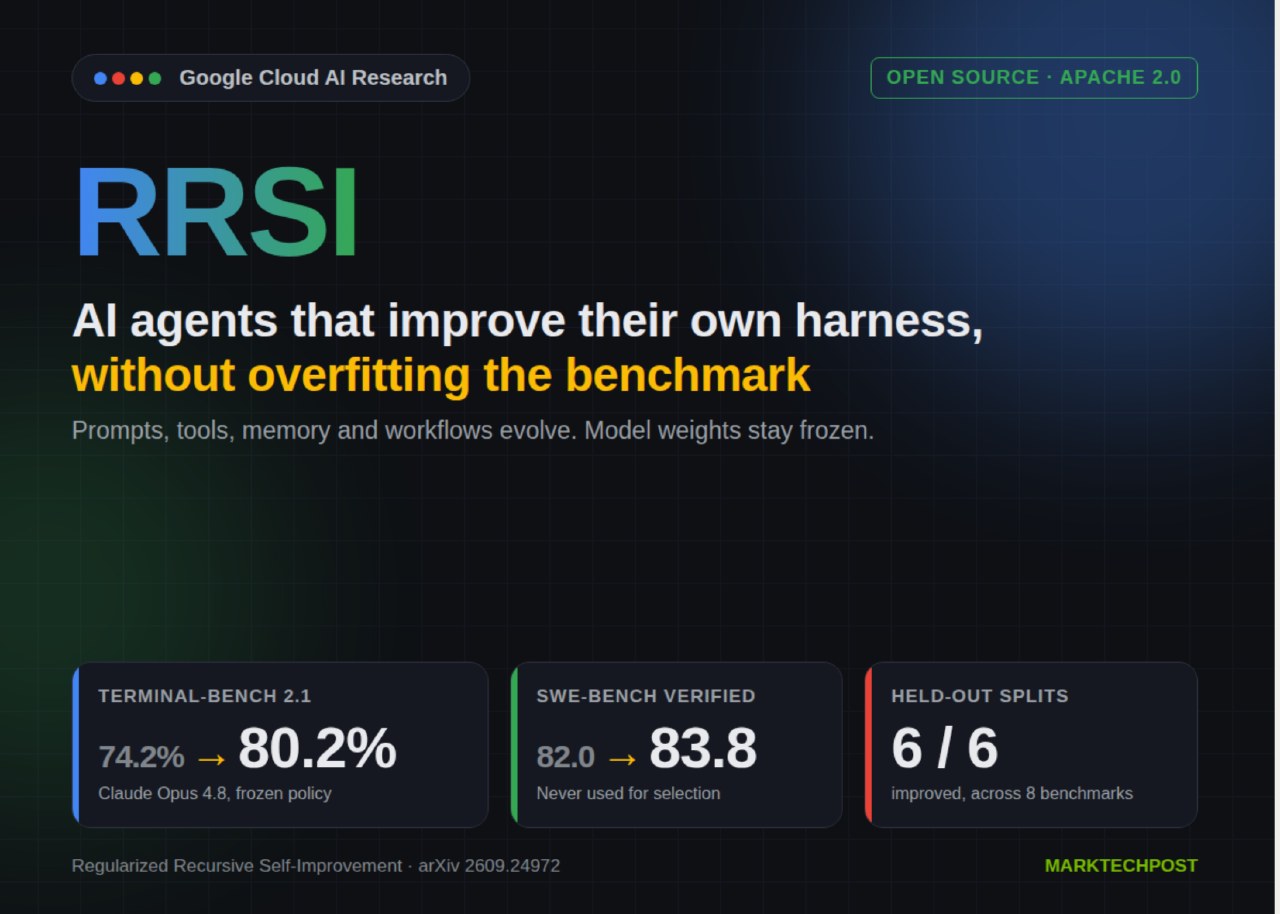
Google Research has released the RRSI framework as an open-source project under the Apache 2.0 license. The system is designed to allow AI agents to improve their own harnesses while avoiding overfitting. It requires Python 3.10 or higher and supports any LiteLLM model string, with default settings configured for Claude Opus 4.8 on Vertex AI.
The research identifies three primary failure modes in self-improving loops: benchmark-specific fitting, noise chasing, and complexity accumulation. To address these, RRSI treats harness components as editable and applies regularization techniques analogous to classic methods, such as L0 for edit budgets, L1 for pruning, and L2 for cost rules.
Performance testing showed improvements across all six held-out splits. Using Gemini 3.5 Flash, the Terminal-Bench 2.1 score increased from 64.6 to 78.7, while SWE-bench Verified rose from 76.8 to 79.0. The framework also demonstrates increased efficiency, consuming 2.42 million policy tokens per trial compared to 3.80 million for unregularized evolution.
The implementation process involves cloning the repository and installing the development dependencies. The coding domain requires Docker and Harbor for operation. Each round of the process drafts two candidates in separate git worktrees, evaluates them, and selects the winner to fast-forward the branch.