

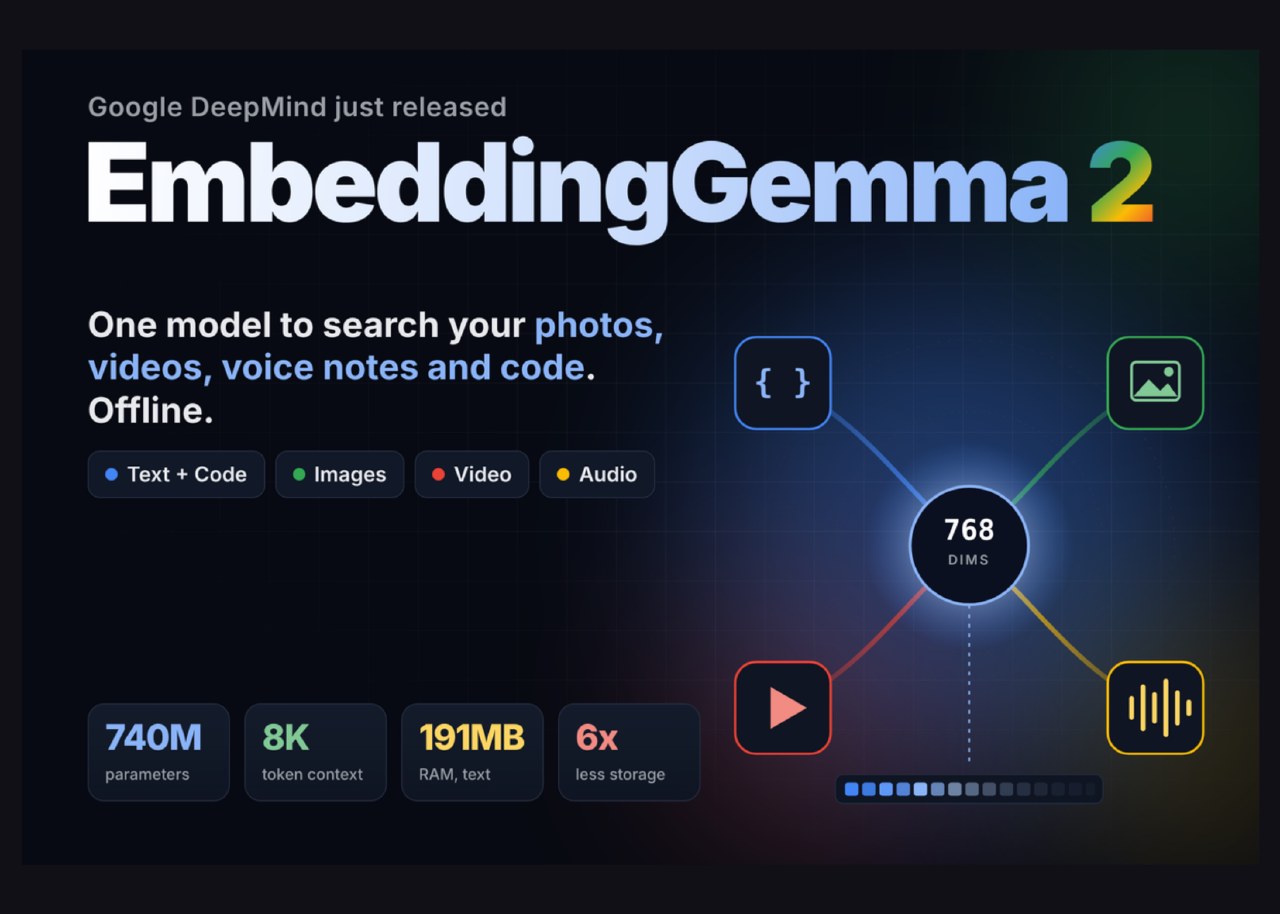
Google DeepMind has launched EmbeddingGemma 2, a multimodal embedding model based on the Gemma 4 architecture. The model is designed to convert diverse content types, including text, images, audio, and video, into vectors within a shared space. Developers can choose between configurations ranging from 270 million to 740 million parameters depending on their specific input requirements.
The model features a context window of 8,192 tokens, which is four times larger than the previous version. It supports Matryoshka Representation Learning, allowing users to truncate vectors to 512, 256, or 128 dimensions to optimize storage. Performance testing on a MacBook M5 Pro GPU showed an inference speed of 37.3 ms per image using a 70-token vision budget.
Resource requirements for the model are optimized for local deployment. On a Pixel 11 Pro, the text-only configuration requires approximately 191 MB of RAM, while the full multimodal version needs 567 MB. Quantization-aware training is utilized to compress weights into INT4 and INT8 formats.
EmbeddingGemma 2 is currently available on Hugging Face and Kaggle. It is compatible with various frameworks, including vLLM, SGLang, MLX, and llama.cpp. Support for Android via ML Kit with NPU acceleration is scheduled to arrive in the coming weeks.



