

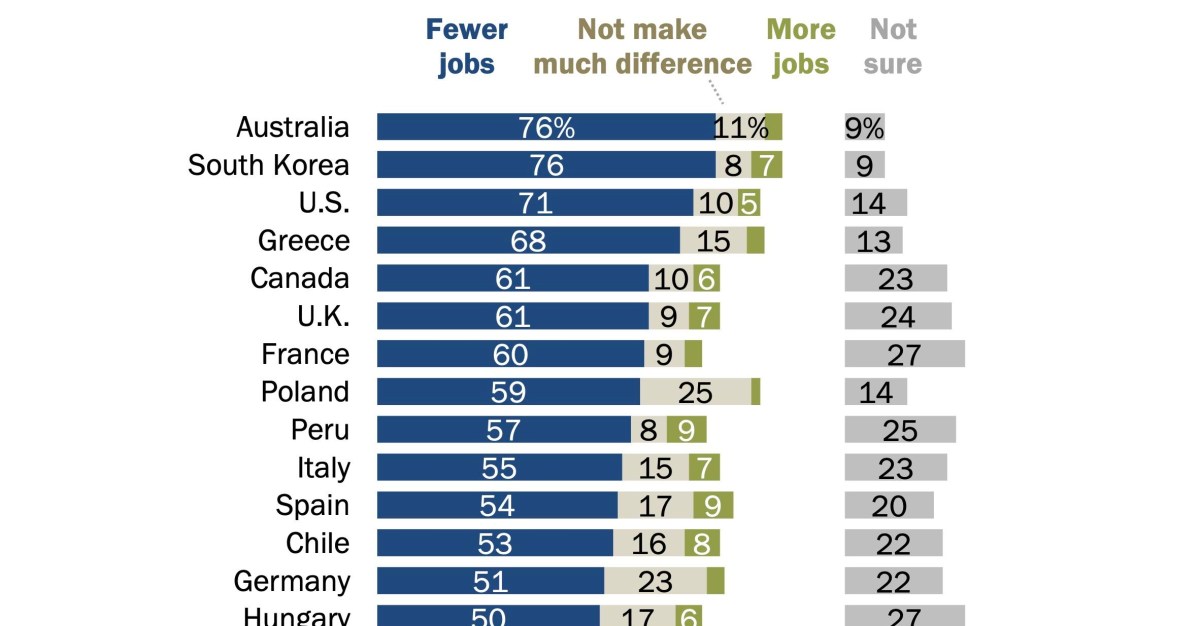
Pew Research surveyed 42,151 individuals across 37 countries between February 8 and May 13. The study reveals that a majority of respondents view artificial intelligence as a significant threat to future employment. In 34 of the 37 nations, participants expect AI to cause more job losses than new opportunities over the next 20 years.
Concerns regarding job displacement are most prominent in wealthy nations. Specifically, 76 percent of respondents in Australia and South Korea, and 71 percent in the US, anticipate negative impacts on the labor market. This aligns with warnings from Anthropic CEO Dario Amodei, who suggested that AI could potentially eliminate half of all entry-level white-collar positions.
The survey also highlights concerns about income inequality, with many respondents predicting that AI will widen the gap between the rich and the poor. This sentiment is particularly strong among individuals in wealthier countries with left-leaning political views. Age also plays a role, as older generations express greater anxiety about the impact of AI on daily life.
Younger adults aged 18 to 34 are increasingly anxious about AI-driven job losses and inequality. In countries including Sweden, Poland, Japan, Australia, Brazil, and the US, concern among this demographic has risen sharply over the past year. Younger people now report levels of worry comparable to those of older generations in the US and Sweden.
Despite these economic fears, public sentiment is not entirely negative. A global median of 41 percent of respondents feel both concerned and excited about the role of AI in daily life. Meanwhile, 37 percent report being primarily concerned, while 13 percent express primarily excitement regarding the technology.



