

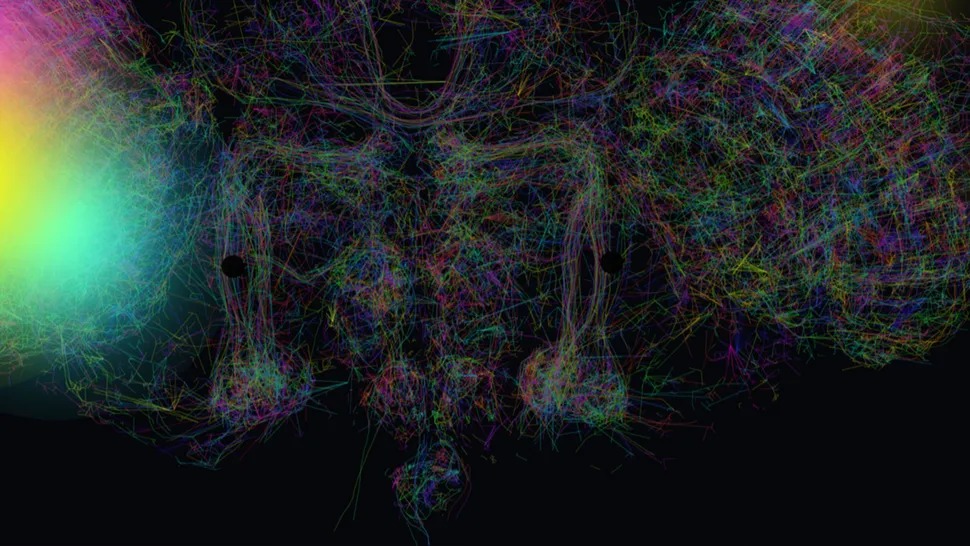
FutureBit has launched HashFly, a proof-of-concept project that simulates Bitcoin mining using a fruit fly brain neural connectome dataset released by Google. The system currently activates 2,914 neural pathways out of the 165,122 total neurons in the MaleCNS v1.0 model.
The simulation mimics photoreceptor cells to process Bitcoin block headers. When the system completes a double SHA-256 hash target, specific PPL101 neurons are activated. Users can manually adjust the difficulty levels, although the current prototype remains significantly less powerful than the actual Bitcoin network.
FutureBit claims that if this organic computing model were fully implemented on real neurons, it could theoretically achieve an efficiency of 1 watt per terahash. This would be ten times more efficient than current 3-nanometer silicon-based ASIC miners, assuming all neurons are dedicated to hashing.
The current web-based HashFly prototype operates at approximately 100 kilohashes per second, which is substantially lower than FutureBit’s Apollo III hardware, capable of 18 terahashes per second. The company plans to expand the simulation to include the entire dataset in future research.


