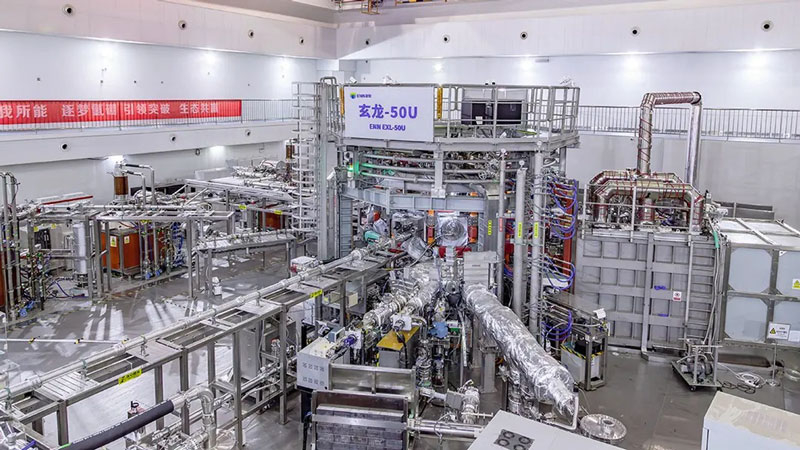
Chinese company ENN Group successfully initiated fusion reactions using hydrogen-boron fuel in its experimental spherical tokamak, EXL-50U. The experiment, announced on September 28, 2026, achieved a rate exceeding 100 million reactions per second.
The process involves protons colliding with boron-11 nuclei, producing three alpha particles. Unlike the deuterium-tritium cycle, this reaction does not generate high-energy neutrons, which prevents radioactive contamination of reactor materials.
To achieve these results, researchers utilized neutral beam injection and radio-frequency heating to create high-energy protons. This method increased the probability of collisions within the plasma, allowing for the detection of helium nuclei.
ENN Group is currently constructing a new facility, Helong-2, with assembly expected to conclude by the end of 2027. The company aims to generate the first electricity from hydrogen-boron fusion by 2030.