

Physicists at the ELI-NP research center in Romania have successfully imaged an object hidden behind a two-meter-thick concrete wall. The experiment utilized a 10-petawatt laser to generate a controlled stream of muons, which are heavy elementary particles capable of penetrating dense materials.
The process involves using the laser to accelerate electrons until they strike a lead target, creating a muon beam. To isolate the muons from other particles, researchers employed a specialized filter constructed from paraffin blocks wrapped in polyethylene sheets.
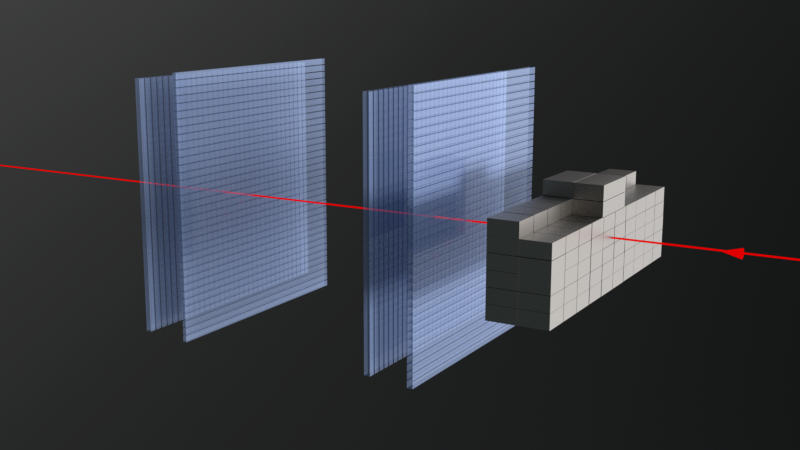
The resulting muon beam was directed through the concrete barrier toward a detector array placed inside a truck on the opposite side. The system successfully captured the shadow of a stack of lead blocks, marking the first time an image has been created using an artificial muon source.
Previous methods relied on natural cosmic muons, which are limited by low flux and fixed angles. The new laser-based approach aims to enable the development of portable scanning systems for inspecting transport containers, rocket hulls, and archaeological structures.

