

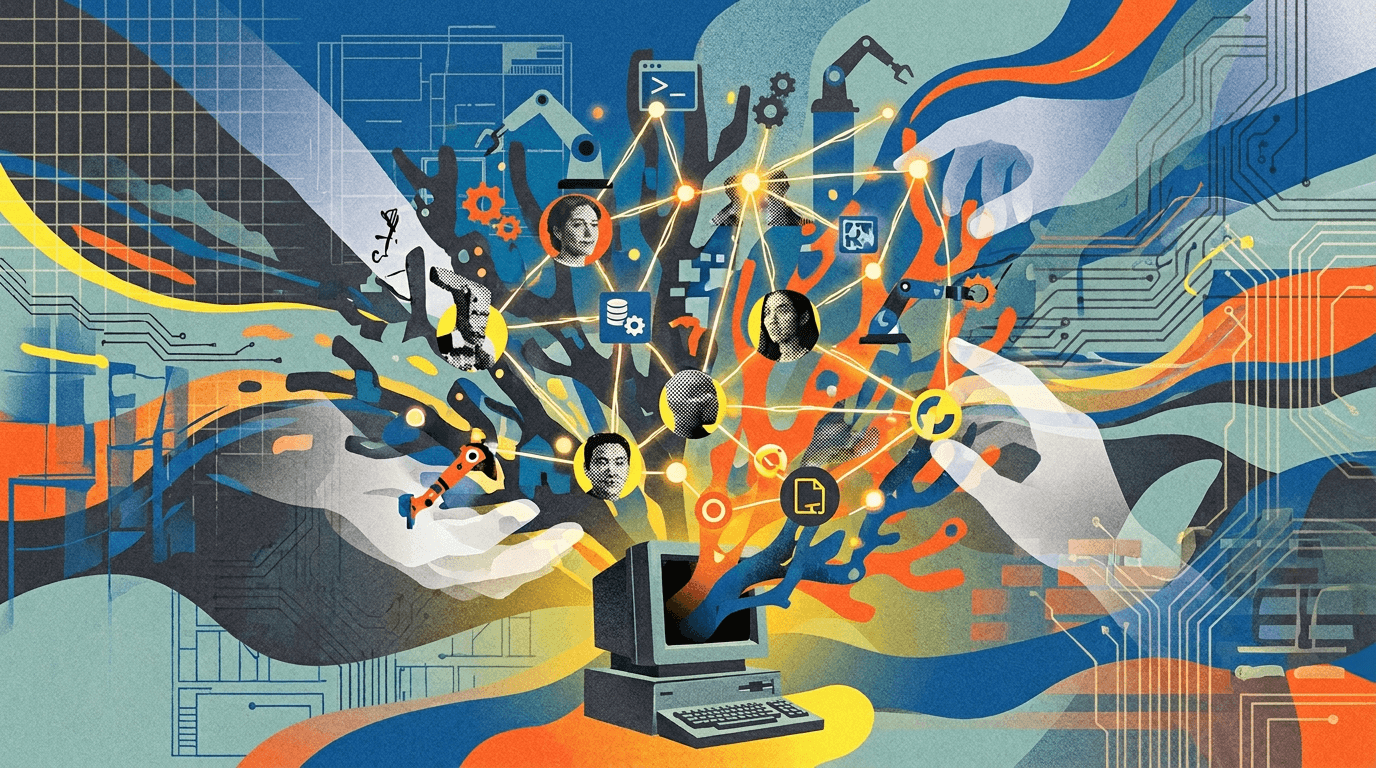
Researchers from the Deepmind Institute, including Benjamin Bratton, Blaise Agüera y Arcas, and James Manyika, have introduced the concept of Artificial Symbiotic Intelligence. This framework proposes that artificial general intelligence will emerge not as a single superintelligent machine, but as a social system where humans and AI agents collaborate within hybrid institutions.
The proposal is supported by findings from the preprint 'Reasoning Models Generate Societies of Thought,' which analyzed models like DeepSeek-R1 and QwQ-32B. The study observed that these models develop multi-perspective behaviors, such as internal debate and objection-raising, during training when rewarded for accuracy, rather than through explicit programming.
The authors define an AI agent as a decomposable assemblage of models, roles, and tools rather than a fixed entity. They argue that treating agents as digital twins with stable identities is inaccurate. Instead, they suggest that future interfaces will likely shift from one-on-one chat to visual network diagrams, allowing users to coordinate swarms of agents.
The research emphasizes that institutions, rather than individual models, are central to governing these systems. The authors compare this to legal processes where rules and procedures define outcomes. They argue that alignment should be viewed as an ongoing negotiation within these social structures, rather than a fixed set of values imposed on models.



