

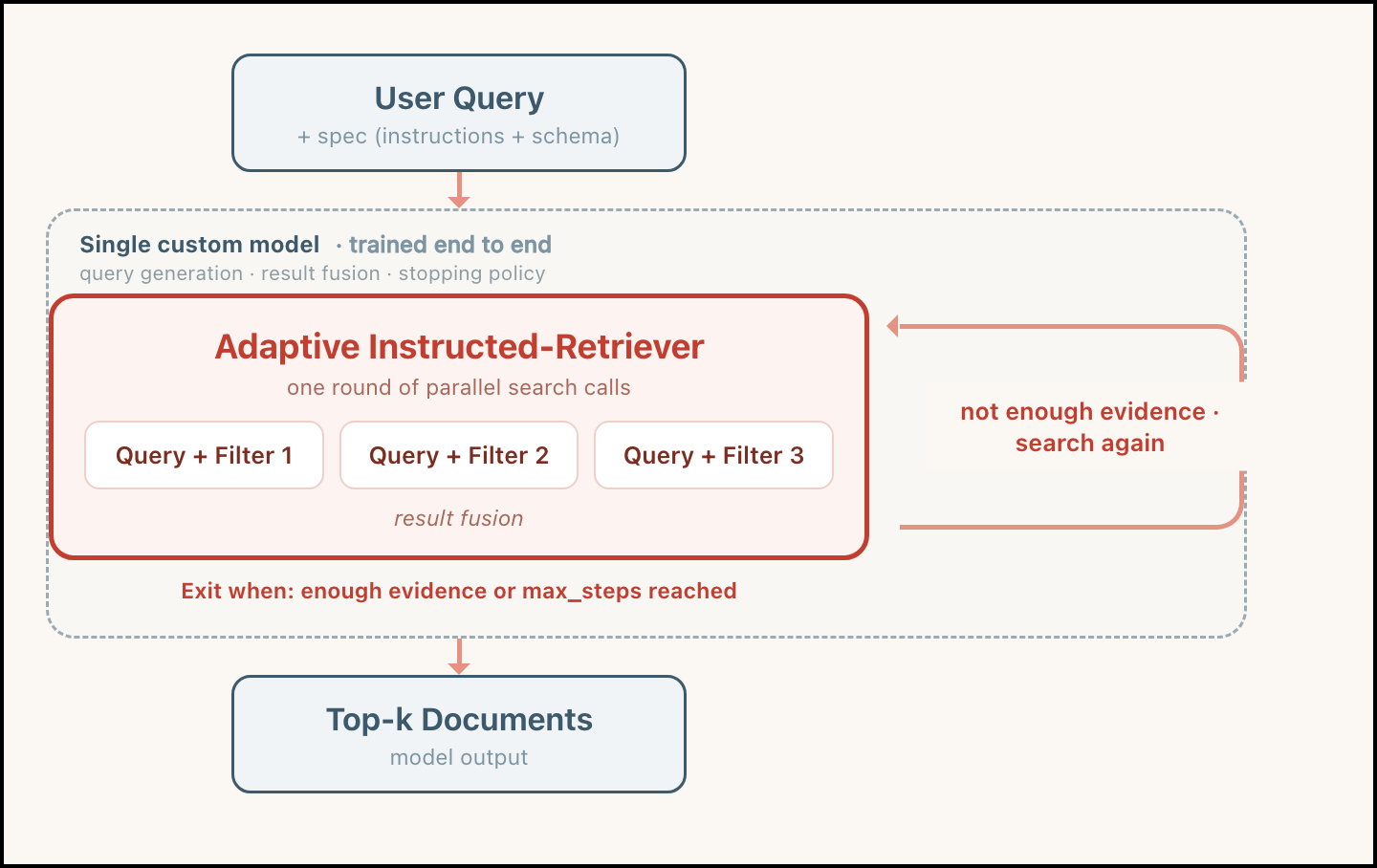
Databricks has expanded its Adaptive Instructed-Retriever model, designed to accelerate response times for AI agents that require multiple rounds of data retrieval. The new model serves as a building block for the company's Genie Code, Genie One, and Genie Agents platforms.
According to Databricks, the model responds twice as fast as Claude Sonnet 5, GPT-5.6 Luna, and V4-Flash from Hangzhou DeepSeek. These performance results were derived from seven internal and external benchmarks covering various domains and search difficulty levels.
The model dynamically manages search steps by allowing developers to set a maximum limit. It automatically stops searching once sufficient evidence is gathered. This approach builds upon the previous Instructed-Retriever-1 architecture, which improved performance by over 70% compared to traditional RAG methods.
Databricks trained the model using synthetic enterprise environments and multi-hop questions, applying online reinforcement learning. The system uses a penalty-based reward mechanism, allowing customers to select checkpoints that balance search quality against latency depending on their specific workload requirements.
In one internal test, the model verified information in two search steps, whereas Claude Sonnet 5 required three steps and GPT-5.6 Luna required four. Databricks has not yet disclosed the model's parameter count, pricing, or general availability details.



