

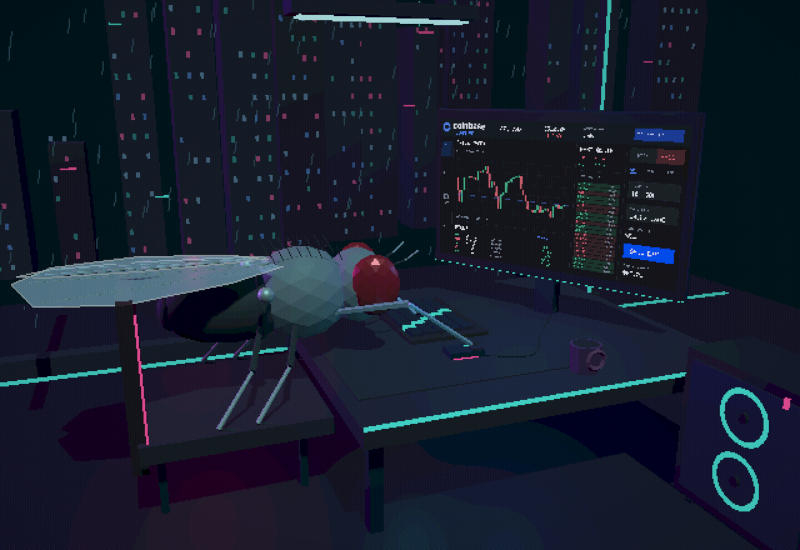
An engineer at Coinbase has launched Stonkfly, an open-source project that uses a simulated fruit fly brain to trade on cryptocurrency markets. The model consists of 166,700 neurons and 25.6 million synaptic connections, processing market charts as visual inputs rather than raw data. The system operates on Linux or macOS, requiring 16 GB of RAM, Python 3.11, and a C++ 17 compiler.
The virtual fly receives visual data via a 320 x 180 pixel projection onto its simulated eyes. It makes decisions every 500 ms based on market updates provided every 60 seconds. The agent is restricted to a maximum of 24 trades per day, with each stake limited to $10. The simulation uses a starting balance of $100 and tracks real-time BTC/USDC price data.
The model employs a reinforcement learning mechanism where portfolio growth triggers dopamine-like signals in 15 neurons, while losses activate two neurons associated with avoidance. The project creator notes that the fly avoids leverage and short positions. The author emphasizes that the experiment is not a proof of trading capability, as current market trends may influence performance.
While the default setup uses a virtual trading environment, the project includes instructions for connecting to a live exchange account. The developer clarifies that the simulation does not involve emotions or pain, focusing solely on the relationship between visual stimuli and synaptic changes. The project is available as open-source software for public review.



