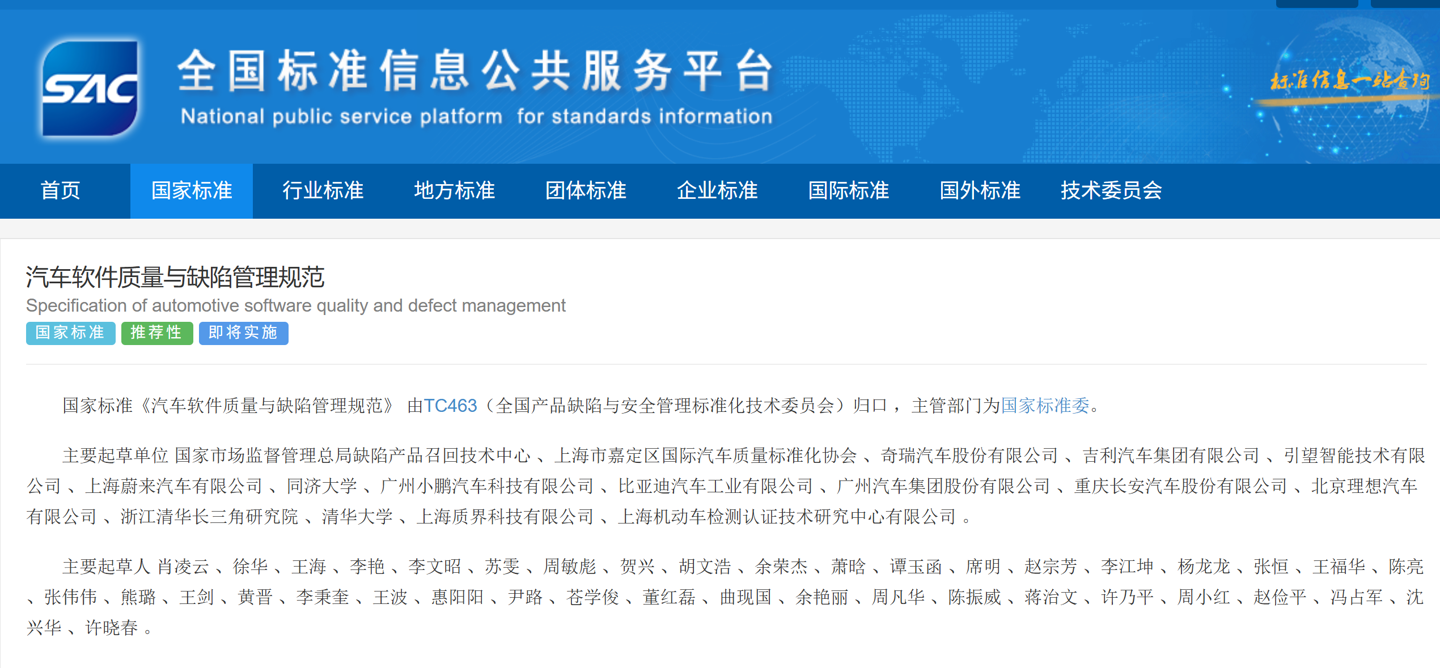
The State Administration for Market Regulation of China has released the national standard GB/T 48140-2026, titled 'Automotive Software Quality and Defect Management Specification.' This new regulation aims to shift the industry focus from reactive defect handling to proactive prevention. The standard will officially take effect on December 1, 2024.
The document introduces a comprehensive management framework based on the PDCA cycle, covering the entire lifecycle of automotive software. This includes requirements for demand analysis, design, integration, verification, and maintenance. It mandates that manufacturers and suppliers establish quality management systems and perform ten key quality assurance activities, including safety management and status monitoring.
The standard covers various software types, including artificial intelligence, embedded systems, and cloud-based solutions. It establishes five critical review nodes throughout the development process, from planning to validation. Companies are required to implement risk assessment mechanisms to categorize software issues and ensure that quality control is integrated into every development stage.
Regarding defect management, the regulation outlines a full-process requirement from initial problem identification to investigation and final resolution. It specifically addresses procedures for remote software updates, known as OTA, to ensure a closed-loop system for defect handling. This framework provides a unified set of rules for the automotive industry to improve software safety and reliability.