

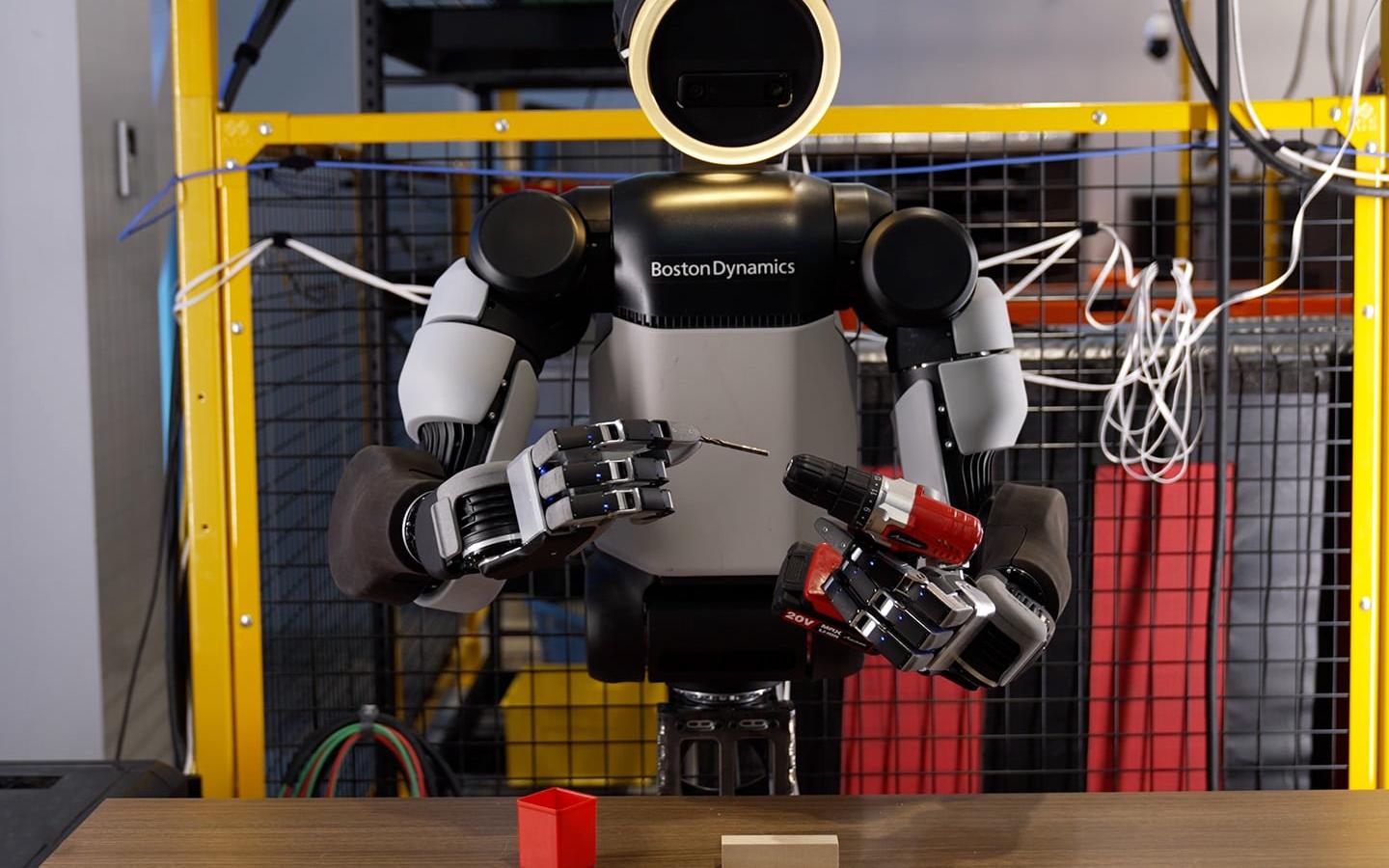
Boston Dynamics has unveiled a new four-fingered hand design for its Atlas humanoid robot, prioritizing industrial utility over human anatomical mimicry. The design features a thumb with four degrees of freedom and three fingers with three axes each, totaling 13 degrees of freedom. This configuration replaces the previous seven-degree-of-freedom model to improve grip stability and tool handling.
The engineering team opted to remove the fifth digit to reduce complexity, cost, and potential points of failure. Each finger is powered by sealed, direct-drive electric actuators, eliminating cable-driven mechanisms. This robust construction allows the hand to support loads exceeding 45 kilograms while maintaining high precision for tasks like operating power tools and triggers.
To enhance tactile feedback, the palm and fingertips are equipped with pressure-sensing matrices that detect contact signals and slippage. The mechanical design is specifically optimized for reinforcement learning, allowing control policies developed in simulations with domain randomization to be transferred directly to the physical robot without requiring further adaptation.
The company emphasizes that the primary goal is to enable reliable manipulation of industrial equipment, such as drills and soldering irons, rather than replicating human anatomy. By focusing on functional grip types, including tripod and pinch grasps, Boston Dynamics aims to increase the robot's versatility in logistics and manufacturing environments.


