

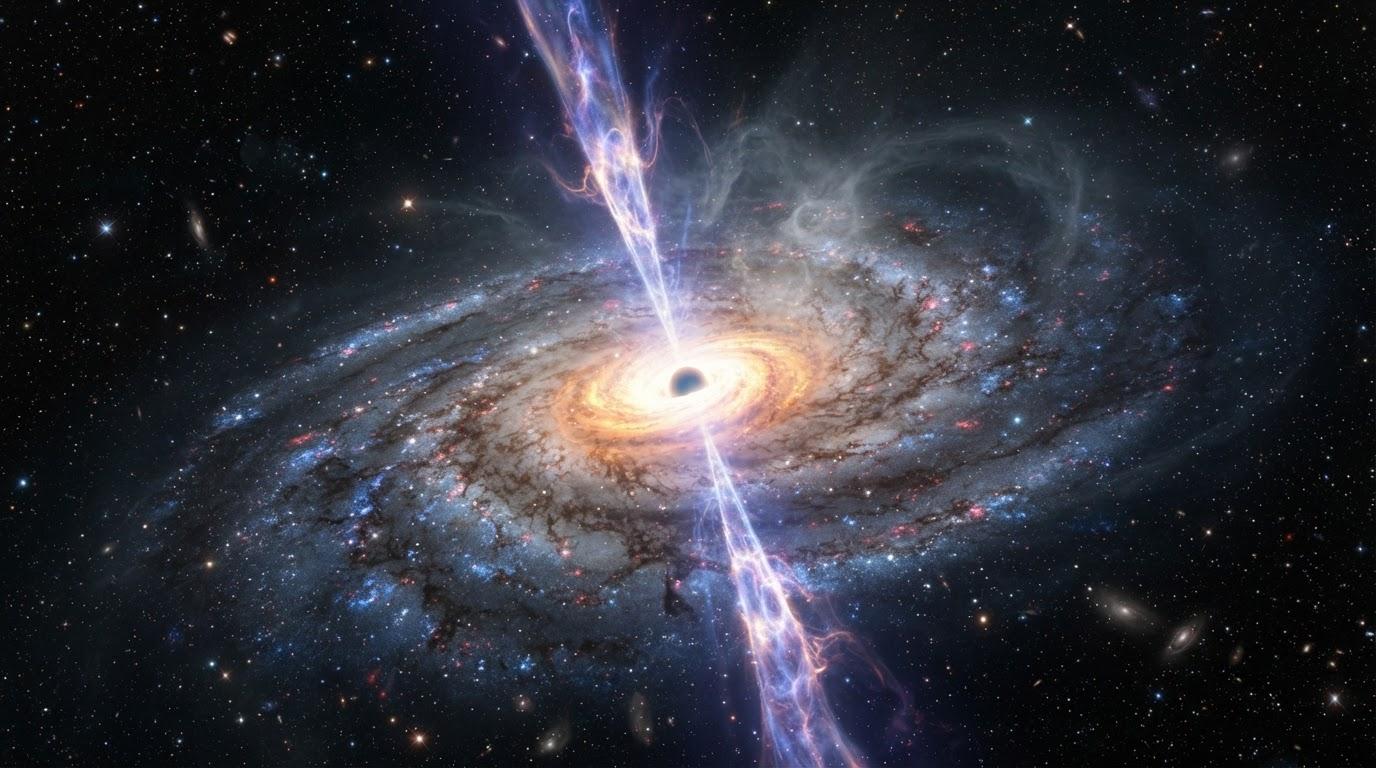
Researchers led by Sanchayeeta Borthakur from Arizona State University and Namrata Roy from the Raman Research Institute investigated how supermassive black holes influence galaxy development. The study, published in The Astrophysical Journal Letters, analyzed the impact of plasma jets on surrounding gas clouds.
The team combined data from the DESI optical survey and LOFAR radio observations to examine hundreds of galaxies. While signals from hydrogen gas were weak in most directions, they were significantly stronger along the path of the jets, indicating energy transfer to the surrounding medium.
The findings reveal that these jets act like narrow beams, heating gas even at the outer edges of galactic halos, hundreds of thousands of light-years away. This heating process prevents the gas from cooling and migrating toward the galactic center, which is necessary for star formation.
The study concludes that black hole activity regulates the evolution of entire galaxies by limiting the availability of cold gas. By heating the gas along specific trajectories rather than uniformly, these jets effectively slow down the birth of new stars across vast cosmic distances.


