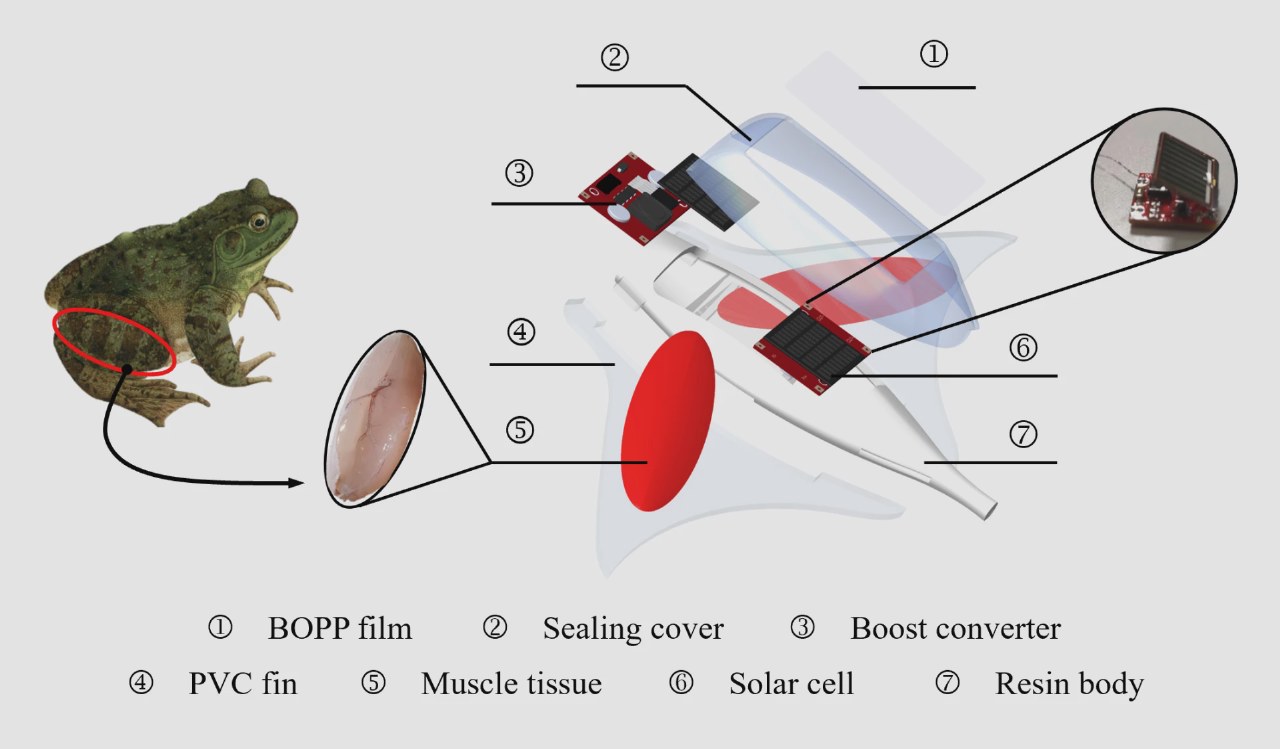
Researchers at the Shenyang Institute of Automation, Chinese Academy of Sciences, have developed a wireless, light-controlled biohybrid robot modeled after a manta ray. The device utilizes natural gracilis muscle tissue harvested from bullfrog legs as an actuator, a departure from traditional laboratory-grown muscle tissues.
The robot is powered by a GaAs photovoltaic module that converts 808 nm near-infrared laser light into electrical signals. This system triggers muscle contractions, allowing for precise maneuvers such as forward movement, steering, and U-turns. The robot achieves a maximum speed of two body lengths per second.
Under optimized electrical stimulation of 1 Hz and 5 V, the muscle generates a stable contraction force of 6.5 N. The tissue maintains electrical responsiveness for up to 11 days, enabling the robot to function reliably for approximately 7 days. The research was published in Advanced Functional Materials.
The design features a minimum turning radius of one-eighth of its body length and a maximum angular velocity of 21 degrees per second. Beyond aquatic navigation, the robot can carry loads of up to 5 grams and move across rigid surfaces. The team aims to integrate onboard energy storage in future iterations.
This technology offers a low-disturbance solution for shallow water monitoring and aquatic observation. The researchers are currently working on extending the lifespan of the biological components and developing flexible neural-like thin-film electrodes to improve signal distribution.