

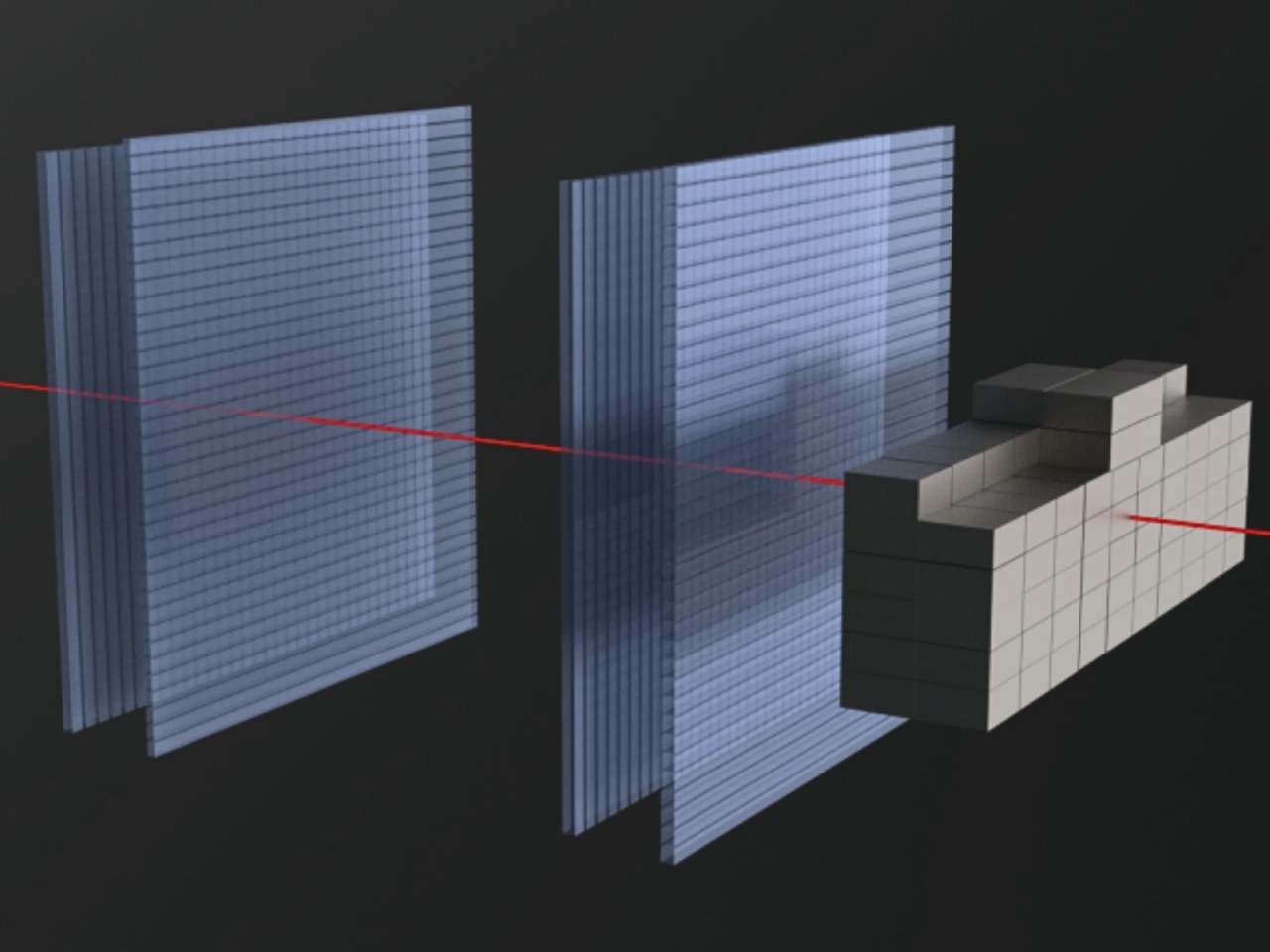
Researchers at the Extreme Light Infrastructure Nuclear Physics center in Romania utilized a 10-petawatt laser to generate a high-energy muon beam. This beam successfully penetrated a two-meter-thick concrete wall to image lead blocks positioned behind it. The process involves the laser accelerating electrons, which then collide with a lead target to produce muons.
Muons are heavy elementary particles capable of passing through dense materials, often surpassing the penetration power of X-rays. While cosmic muons are naturally used for scanning structures like pyramids, their low flux and fixed angles limit practical application. The team designed a specific filter using polyethylene and paraffin to isolate the muon beam for this experiment.
The resulting images of the lead blocks were captured by a detector array placed inside a vehicle on the other side of the concrete barrier. Although the current imaging resolution remains limited, the researchers suggest that future developments could lead to portable systems for inspecting rocket casings, geological formations, or historical foundations.
This experiment follows previous efforts by international teams, including researchers from Lawrence Livermore National Laboratory and Colorado State University, who had previously attempted similar particle imaging. The current findings have been released as a preprint for further review.


